
When Santa visited the S.S. Thurso – and Europe sent Hull its first Christmas trees
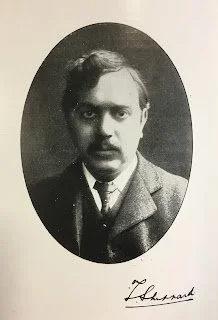
CURATOR: Thomas Shepperd

The Way it Was
In partnership with Hull History Centre
December is of course, Christmas. So, what better time to delve into the archives and uncover Christmas of yesteryear by staff past and present…
Reported sighting of Father Christmas
By Caoimhe West, archive assistant
Hull residents owe a debt of gratitude to Thomas Sheppard, Hull curator extraordinaire.
Under his watchful eye and professional guidance, from his initial appointment as Hull curator in 1901 to the date of his retirement in 1941, he had been involved in the creation of nine museums in the area and has left a lasting legacy.
He was a remarkable man who was for the most part self-taught since he was only formally educated to elementary standard.
For the first 11 years of his working life, he was employed at a railway clerk and then in the Dock Offices.
He spent his spare time attending courses which included the preservation of natural history specimens. Some of the courses were in London where he achieved a First-Class Stage Certificate for Geology.
Sheppard was greatly influenced by two men. The first was J.R. Mortimer, the Driffield corn merchant and archaeologist whose greatest work is regarded as Forty Years Research in British and Saxon Burial Mounds in East Yorkshire.
Sheppard’s passionate interest in geology was primarily due to the encouragement of Percy Fry Kendall, the first professor of geology at Leeds University. Sheppard’s The Lost Towns of the Yorkshire Coast has acted as an invaluable guide to present and future geologists by recording the geological changes that have taken place in the area.
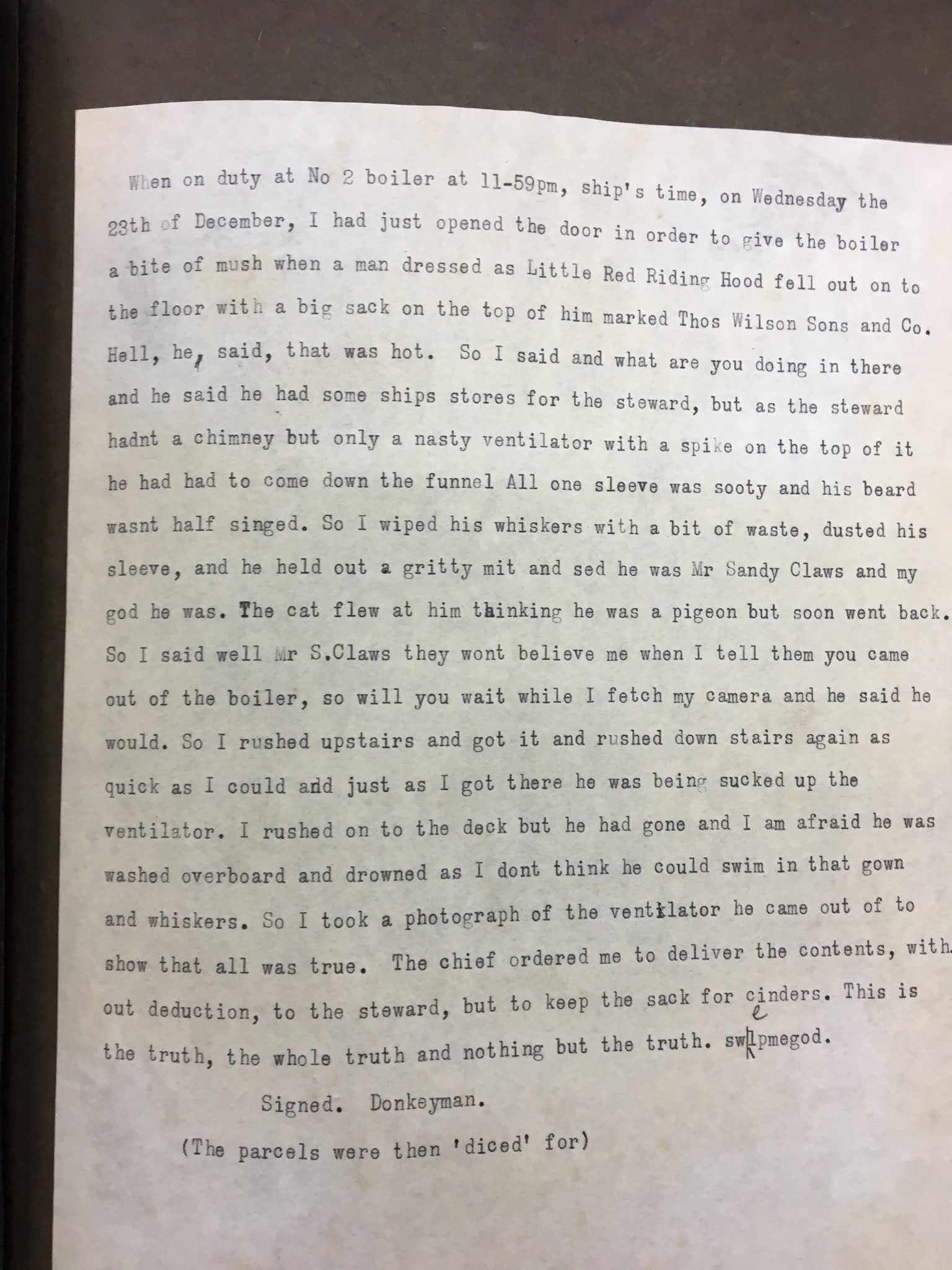
PROOF?Eyewitness statement regarding sighting of Father Christmas
Sheppard, in his role as curator, published numerous books and papers – predominantly catalogues, histories and introductory geological works. He also was responsible for the writing and editing of innumerable Hull Museum publications. He was a prolific writer and editor.
Therefore, I was bemused to find an account in his personal journal – Journal of a Trip on the S.S. Thurso, 1930-1931 – by the Passenger, Mr. T. Sheppard – of a sighting of Father Christmas!
Surely this would been one of the most remarkable academic papers to grace any scientific journal of repute. Although Sheppard did not witness the event himself, he wrote down “the Witness Statement” of lucky crewman’s incredible sighting in this journal.
Christmas Day on board the ship was celebrated with gusto after the exciting events of “the night before” and Sheppard makes a note of the Christmas Day menu.
It wasn’t until I saw that the plum pudding didn’t have plums in it, that I ever thought to question why our traditional Christmas pudding was originally called plum pudding, when no plums are called for.
The reason is that it has its origins in medieval England and the use of the word ‘plum’ in pre-Victorian times refers to dried fruit of any variety, whether dates, prunes, sultanas or currants.
Although you might not be as fortunate as Sheppard’s shipmate in actually seeing the “real Father Christmas”, I wish you all a very Happy Christmas!
Hull and its Friendship Christmas Tree, the early years
By Paul Leaver, archivist/librarian
Today, the Christmas Tree in Hull’s Queen Victoria Square has become a very recognisable part of our city’s festive celebrations.
This tradition goes back to the early years after WWII, when people and cities across Europe were reaching out to build bridges and develop friendship links.
Using the council minutes, additional council records within C TMM/1/27 and the Hull Daily Mail, the early years of these trees are chronicled here:
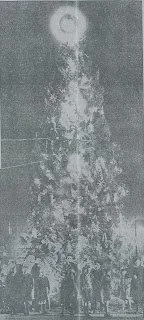
LONG TRADITION: Christmas tree lights switched on 1949
1949
Hull's first Friendship Christmas Tree was from Ǻlesund (Aalesund), Norway, beating Haugesund to it.
The gift was arranged by the resident Norwegian Consul in Hull, Mr T.A. Gjertsen. It was only the second gift of a tree to the United Kingdom, the first being for London.
The tree was erected in Queens Gardens, unlike the previous year when it had been on King Edward Street, which was unavailable, as it was being redeveloped.
It was switched on by 18-year-old Aase Steffenssen, the daughter of Ǻlesund Councillor Sigurd Steffenssen. Aase was in the UK studying English in Hertfordshire at the time.
1950
Another Christmas tree from Ǻlesund (Aalesund), Norway, brought over by Councillor S. Krabbe Knudsen. Again, they beat Haugesund to it.
Erected in Queens Gardens and described as the Friendship Tree.
1952
Christmas tree from Ǻlesund erected in Queens Gardens and only set up and switched-on on Christmas Eve, due to unforeseen delays.
1953
Christmas tree from Sweden but purchased from Billingham Urban District Council after they had transport problems. Lights were switched on December 18.
1954
52ft Christmas tree from Helsinki (listed as Helsingfors, the Swedish version of the name, in the council minutes), Finland, along with a Finnish woman’s national dress costume. This was worn at the presentation by the then 24-year-old English language student, Kirsti Salakoski.
The tree was officially presented by the Finnish Consul, Ambrose Good, and switched-on on December 17.
In return for the tree, Hull hoped to give Helsinki 50 white rose bushes.
1955
Christmas tree from Aalborg, Denmark.
1956
Christmas tree presented by Dr V.W.D. Hale of the Britain-Norden Society and grown on the estate of Maj. P.M. Stewart in Pocklington and erected in Queens Gardens, December 11.
1957-1958
Like 1956, there were no foreign trees in these years, but there was still a tree in Queens Gardens in 1957 and in the flower beds at Paragon Street and Jameson Street in 1958.
1959
Christmas tree from Haugesund. Haugesund had tried to send one back in 1949-1950 but had been beaten to it by Ǻlesund.
A 30ft tree, sited at the corner of Buckingham Street and Holderness Road and lit up on December 8, again by the Norwegian Consul, Mr T. A. Gjertsen, who had done the same 10 years earlier.
Like 1954, in return for the tree, a few months later, Hull gave Haugesund 120 white rose bushes.
1960
No mention of a large tree, only small ones in various parks.
1961
Christmas tree from Haugesund. No switching on ceremony that year as the weather was too inclement. Tree sited at the corner of Paragon Street and Prospect Street.
1962
Christmas tree from Norway mentioned. Tree at the corner of Paragon Street and King Edward Street.
1963
Christmas tree from Haugesund. Tree at the corner of Paragon Street and King Edward Street, same site as the previous year.
1964
Christmas tree from Haugesund. This was to be the last as changes in legislation brought in by Ministry of Agriculture, Food and Fisheries (MAFF) under the Plant Varieties and Seeds Act, 1964 meant a licence would be required from the Forestry Commission which was going to cause issues.
How did the city council get these trees from Europe?
Delivery of the first tree, in 1949, was arranged by the Honorary Consul for Norway in Hull, Thomas A. Gjertson.
But a note in the council minutes in 1957 gives us a clue as to the source of some of the others, as the area officer of the British Council reported that he had no knowledge of any offers of trees that year.
This suggests the British Council, the UK’s international organisation for cultural relations and educational opportunities, was involved in the process as well on occasions.
However it was arranged, the Christmas trees were immensely popular and as well as providing some brightness during the festive period, they perhaps captured the spirit of the times, a sense of hope after difficult years.