
Revolutionary spinal surgery offered at Hull Royal Infirmary

MAKING A DIFFERENCE: Fundraiser Ruth Knowles, centre in white jacket
By Simon Bristow, Co-Editor
Patients with spinal conditions including herniated discs, spinal stenosis and spinal infections are to benefit from a revolutionary form of keyhole surgery.
Hull Royal Infirmary is to offer patients with spinal disorders and degenerative spine conditions the state-of-the-art spinal surgery after a major investment in a Mobile Imaging System (MIS).
The hospital’s highly skilled team of neurosurgeons can now perform Endoscopic Spine Surgery (ESS), a minimally invasive surgical technique where a small probe and camera is used through a keyhole incision to perform surgery as a day case procedure.
Shuaibu Dambatta, consultant in neurosurgery at the infirmary who performs complex spinal surgeries, said: “Our patients should feel confident that they will benefit from latest surgical advances when they come to our hospitals.
“Instead of making large incisions we can make much smaller cuts, less than the size of a finger, to operate on the spine so it’s a much better, safer and less traumatic experience for patients.

“As the cuts are so small, the surgery is far less invasive and safer for patients, who can have the surgery as a day case, with most able to go home that same day to begin their recovery.”
NHS Humber Health Partnership bought the equipment, complete with a special set and scope, thanks to the generosity of independent hospital charity WISHH and Ruth and Tony Knowles, who have raised more than £176,000 for the team in memory of their daughter Emma-Jayne, who died of a brain tumour two weeks before her 23rd birthday in 1998.
The couple, of Sutton on Sea in Lincolnshire, were awarded the British Empire Medal in the New Year’s Honours List in 2014 and although Mr Knowles died last year, Mrs Knowles has continued to fundraise and was at the hospital this week to learn about the new equipment.
Mrs Knowles said: “Every year, I speak to the neurosurgical team and I ask them what equipment they might be looking to purchase that year, and what would benefit patients most. They come back with a list of equipment, we have a chat and then we look to make that happen.
“It’s always nice to be invited back to Hull Royal; it’s fantastic to see the equipment that’s been purchased and hear about what it can do, but it’s great just to see all the neurosurgical team too, they’re such a fantastic, dedicated group of people.
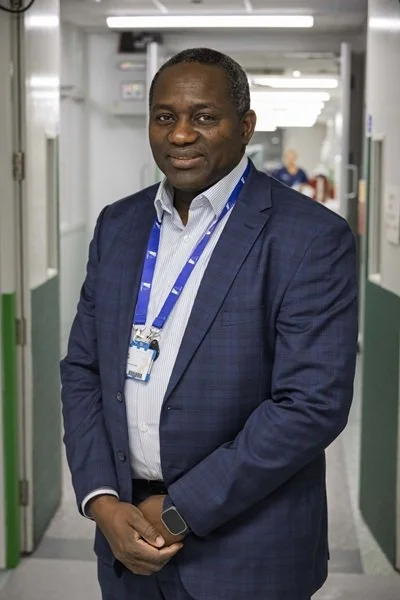
‘MOST PATIENTS WILL BE ABLE TO GO HOME THE SAME DAY’: Neurosurgery consultant Shuaibu Dambatta
“We’ve been fundraising now for 27 years and in that time, we’ve raised a total of £176,081.50. Tony and I always said that fundraising won’t bring Emma-Jayne back, but what we can do is help the neurosurgical team to help other people.”
Sue Lockwood, WISHH charity chair, said: “The WISHH charity welcomed the opportunity to support the Knowles family and the Neurosurgical Department to make this new minimally invasive procedure a reality in Hull. This is a procedure which will benefit many patients in the coming years, and it is only thanks to the support and generosity of local people that the WISHH charity has the funds to support such initiatives.”
As well as the new equipment, the partnership, which runs Hull Royal, Castle Hill Hospital, Goole and District Hospital, Diana, Princess of Wales Hospital in Grimsby and Scunthorpe General Hospital, has also bought a computer model of the spine called an UpSurgeon Trainer, which will be used to train doctors in the new form of the surgery.
Consultant neurosurgeon Chittoor Rajaraman said: “At a time when the NHS continues to face significant challenges – particularly from a financial perspective – WISHH and the Knowles family have gone above and beyond to help us secure this vital equipment.
“We are extremely grateful for their contribution.”