
Nuremberg trials recording equipment provides finishing touches to live show
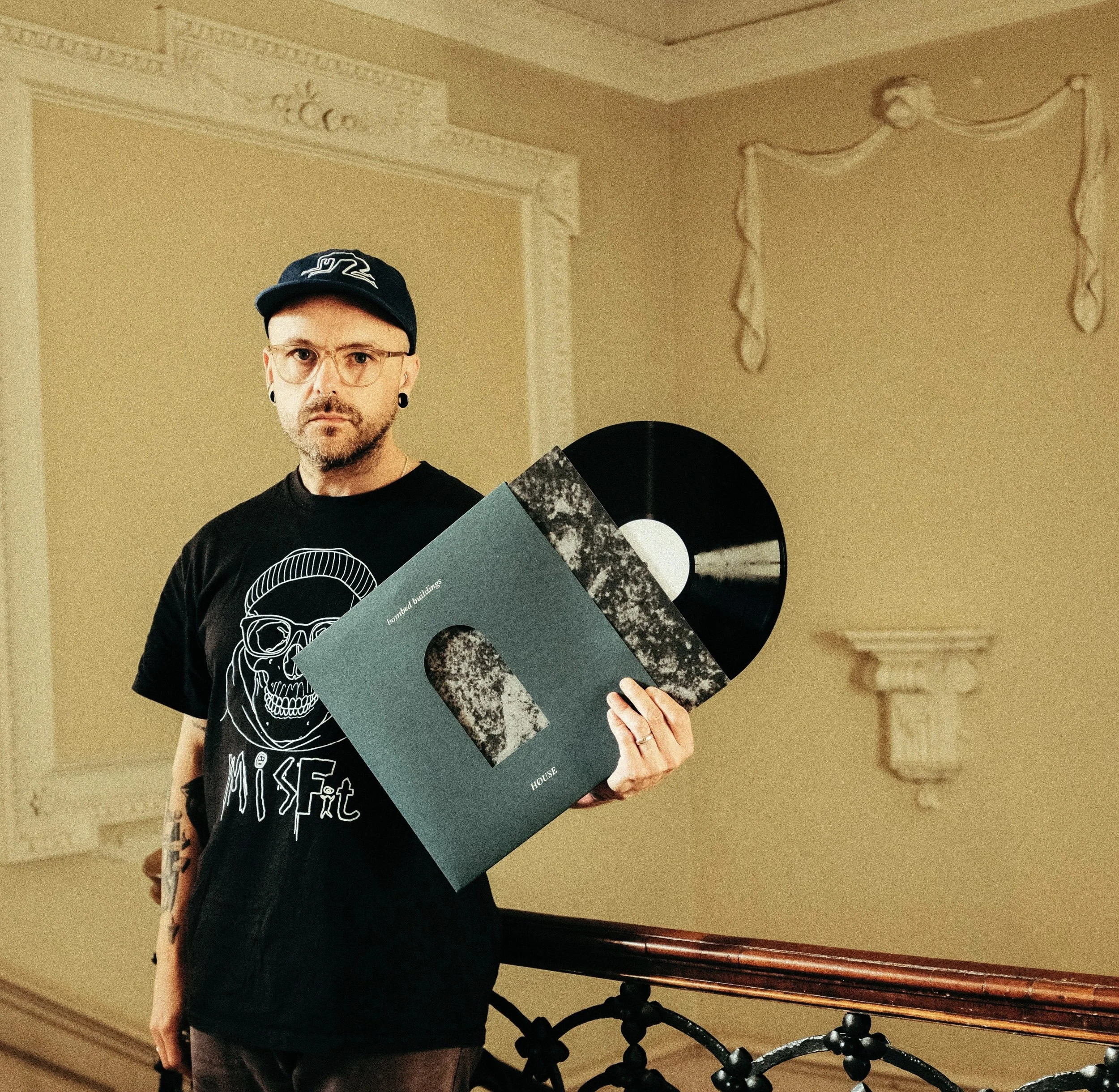
‘EACH ONE IS UNIQUE’: Stewart Baxter in Maister House
By Phil Ascough
A live performance of improvised sound and vision inspired in part by the legacy of war is to take on an additional dimension with the release of vinyl records – each of them a limited edition of one – produced on equipment used 80 years ago to transcribe the Nuremberg trials.
The creator of Bombed Buildings – House is Stewart Baxter, drummer in the Hull-based Indie band LIFE and founder of Hinterland Creative, a business working in photography, design and project management.
The records have been cut at Rare Tone Mastering in Leeds, where Ben Pike used a Presto 28N dual lathe which recorded the Nuremberg trials and was then hidden away in storage until emerging during the 1960s. Ben bought it from a contact in Manchester, who had brought it to the UK ten years ago.
Stewart said: “In the Second World War, Hull was the most bombed city outside London. Working with Ben was remarkable for the link between his equipment and the war, and for the way we were able to produce unique recordings.”
Stewart had heard from others about the impact of the war in the Hessle Road area, with almost entire streets being wiped out and rebuilt. He has first-hand experience of the demolition and renewal process which continued years later.
Now 45, he said: “When houses were demolished as part of the regeneration, we nicknamed them ‘Bombed Buildings’. I have so many memories of playing in them. It was such a big part of my childhood and I can still smell the brick dust.”

CREATIVE: Ben Pike with the Presto 28N dual lathe which he uses at Rare Tone Mastering
When LIFE were forced off the touring circuit by the pandemic Stewart began to explore ambient music, addressing his mental health during lockdown and picking up a commission from Freedom Festival and Absolutely Cultured in Hull.
That experience inspired him to look and listen differently when, two years ago, he set up a studio in Maister House with the support of Danny Thompson, creative director, producer and founder of Eclectic Music.
Under Danny’s management, the Grade I listed former merchant’s house, which dates back to 1743, is a hub for various creatives and provided a source for inspiration and a quartet from Eclectic Music who contributed cello, violin, bass clarinet and French horn.
Working with Dr Mark Slater, a composer, producer and musicologist at the University of Hull, Stewart set about making music to match the space. As they progressed, they secured funding from Help Musicians UK and Hull City Arts to develop their project.
Stewart said: “We started experimenting in the main stairwell and on the first landing – jamming some ambient cassette tape loop and guitar and putting mics in the stairwell.
“Being here really made me think about how space makes such a difference to an improvised performance. It inspired me to want to capture that, and when we listened back to the recording there was a 12-minute track that was perfect from start to finish.”
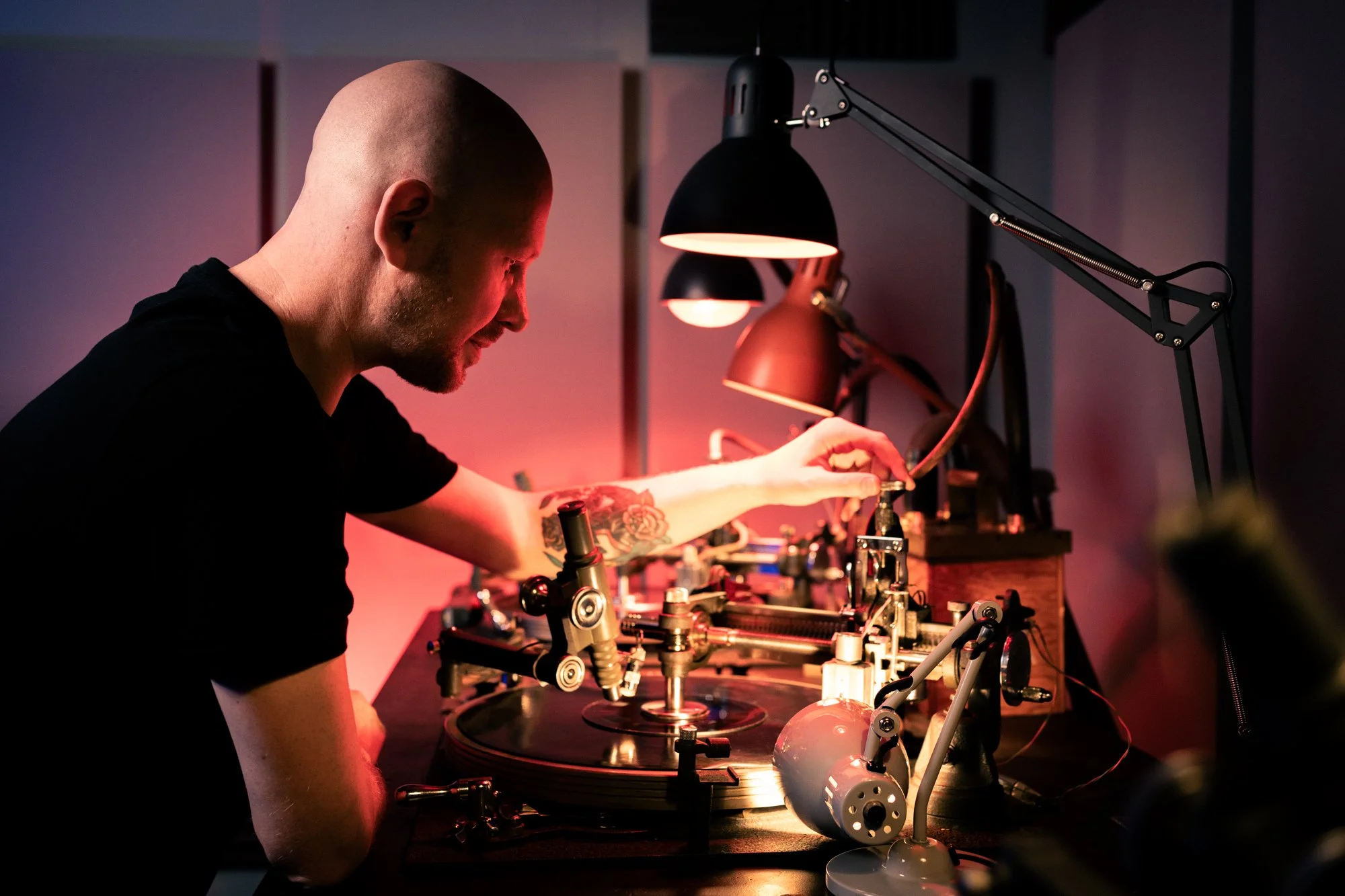
SOUND AND VISION: Ben at work
Stewart sent the work to mix engineer Maurizio Borgna in Italy as thoughts turned to recording formats.
A conversation with Josh Williams at G F Smith, founded in Hull as paper merchants in 1885 and with people and premises devastated by both World Wars, led to the idea of hand-making some vinyl records.
Now the UK’s largest specialist paper company, G F Smith created the sleeve to a design which draws on the building’s character, from the scuffed surface on the flooring at the entrance to the colour schemes of the stairwell and studios.
The screen printing was done by Makerspace at Hull Central Library and by local firm Misc Print Co.
The product was taken to the next level by Ben, whose Presto 28N double lathe is believed to be the last working machine of its kind in the world.
Made in 1941 by the New York firm Presto Recording Corporation – described in archives as “a powerhouse in the broadcast and recording industry” – the lathe was one of five shipped to Germany at the end of the Second World War by the US Armed Forces to make transcription discs of the Nuremberg trials, which ran from November 1945 until October 1946.

UNIQUE: Maister House will be the venue for a live performance of Bombed Buildings – House
Afterwards it is believed the lathe went to Radio Free Europe, before being dismantled for storage in Germany and then Switzerland. A contact of Ben’s in Manchester drove to Switzerland in a Transit van to collect it. Ben helped to rebuild it, and then bought it.
Between them, Ben and Stewart came up with the idea of making each record completely unique instead of the standard of them all being the same.
Stewart sent the track to 20 people around the world – writers, poets, friends – and asked them to listen to it, write something and send it back as a voice note. Contributors include rap musician Chiedu Oraka, aka the Black Yorkshireman, Kate Stables of This is the Kit, French musician and actor Jehnny Beth, and Hull-based poet Audrey Dunne.
Stewart said: “You will be the only person in the world with that record – it’s the opposite of Spotify and music for the masses, where you are always chasing numbers and streams.”
The records and a digital download will be sold at the launch performance at Maister House on Tuesday, October 7. Part of the Unthinkable Film Festival, the event will also feature a documentary made by James Cooper, a young film maker based in Maister House, of the creation of everything from the first recording to the final print.
With a capacity of 50 seated and another 30 standing, Bombed Buildings – House promises to an intimate and emotional show.
For booking details for Bombed Buildings – House and the Unthinkable Film Festival visit https://unthinkablefilmfestival.com/
