
The city’s lost museum

DESTROYED: The war-damaged warehouses behind Wilberforce House

The Way it Was
In partnership with Hull History Centre
By Kyle Thomason, archivist/librarian at Hull History Centre
The Hull ‘Old Times’ Museum was the brainchild of the director of Hull Museums, Thomas Sheppard. It was heralded at the time as a one of a kind, there would be: “Nothing like it in the country when complete” (Hull Daily Mail, 24 July, 1935)
The impetus for Hull’s new museum came from Sheppard’s desire to save aspects of a city that were vanishing with little trace, he lamented that: “For more years than I care to remember, I have watched the demolition of old properties, the changes in the streets and roadways, in the methods of transport, lighting, and engineering…in the march of progress”. (Hull’s Old Time Street, Hull History Centre)
Since his appointment as curator in 1904, Sheppard managed to house and salvage many items, and when discussions were had relating to the demolition of the corporation’s warehouse behind Wilberforce House (known as Wilberforce Warehouse), Sheppard had another idea. In 1931, he suggested that the building be used to reconstruct a Hull street from a few centuries ago.
He would go on to list several buildings that would make up the interior, suggesting that he had been thinking about the project for some time. The warehouse was four stories high and nearly 40 metres long. Sheppard’s new construction would take up the first two floors of the warehouse and by 1935, the museum had a dozen shops and buildings.
The exhibits ran down both sides of the warehouse and the floor was paved in slabs and cobbles in keeping with the period. Down the centre of the street ran a gully paved with “petrified kidneys” like the Hull streets of old.
The following is a list of the buildings and some of their contents in Sheppard’s ‘Old Times’ Street:
Tavern: Its frontage came from the Talbot Hotel in Scale Lane, with fittings and features from the Greenland Fisheries and the Crown Hotel in Hull.
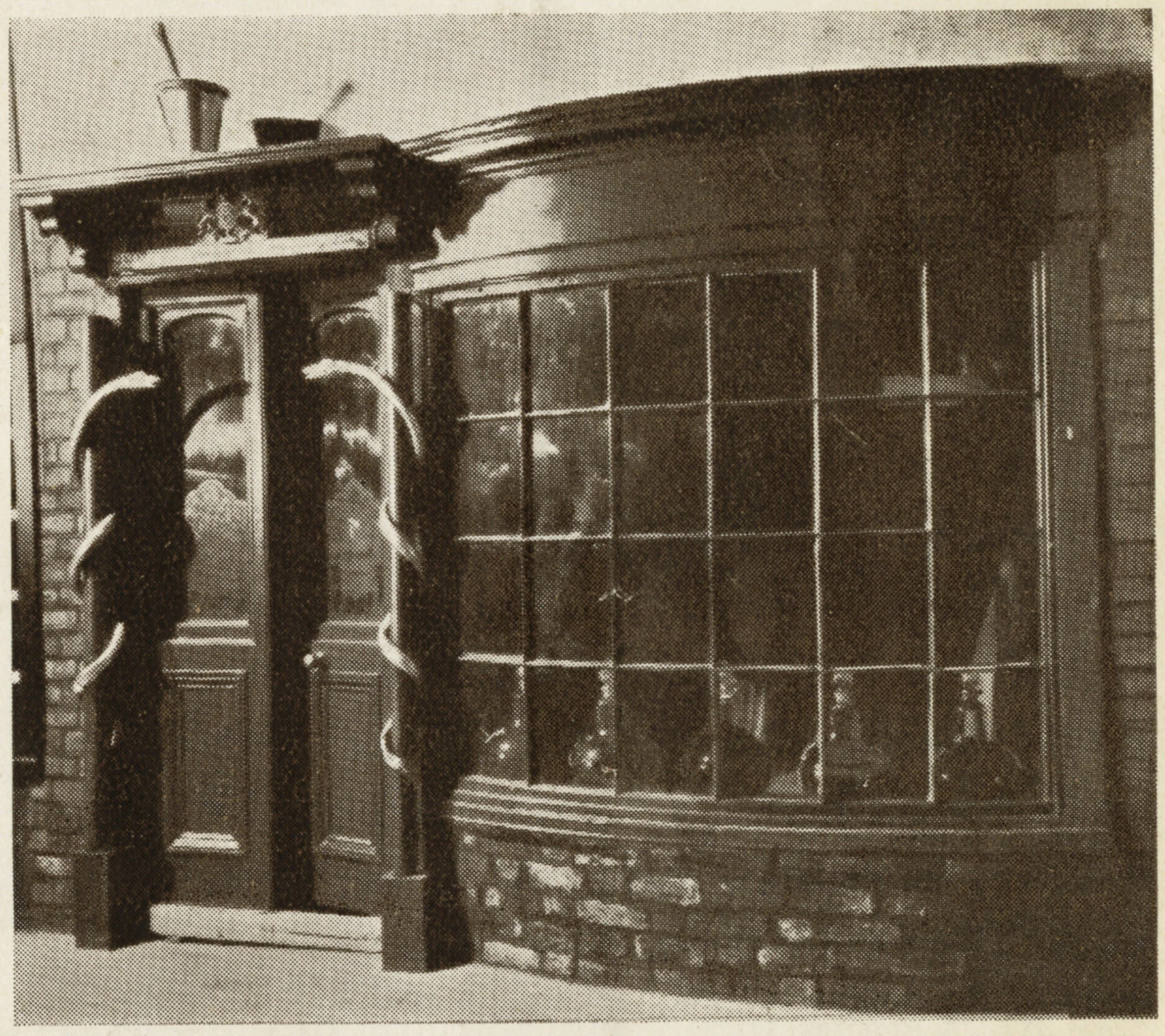
STRIKING FRONTAGGE: The chemist’s shop, circa 1935
Chemist: The frontage came from Hertfordshire whilst the entrance way hosted two impressive golden serpents that came from an old chemist’s shop in Howden. Above this was a board from Hall’s Chemists shop on the corner of Spring Bank and Beverley Road.
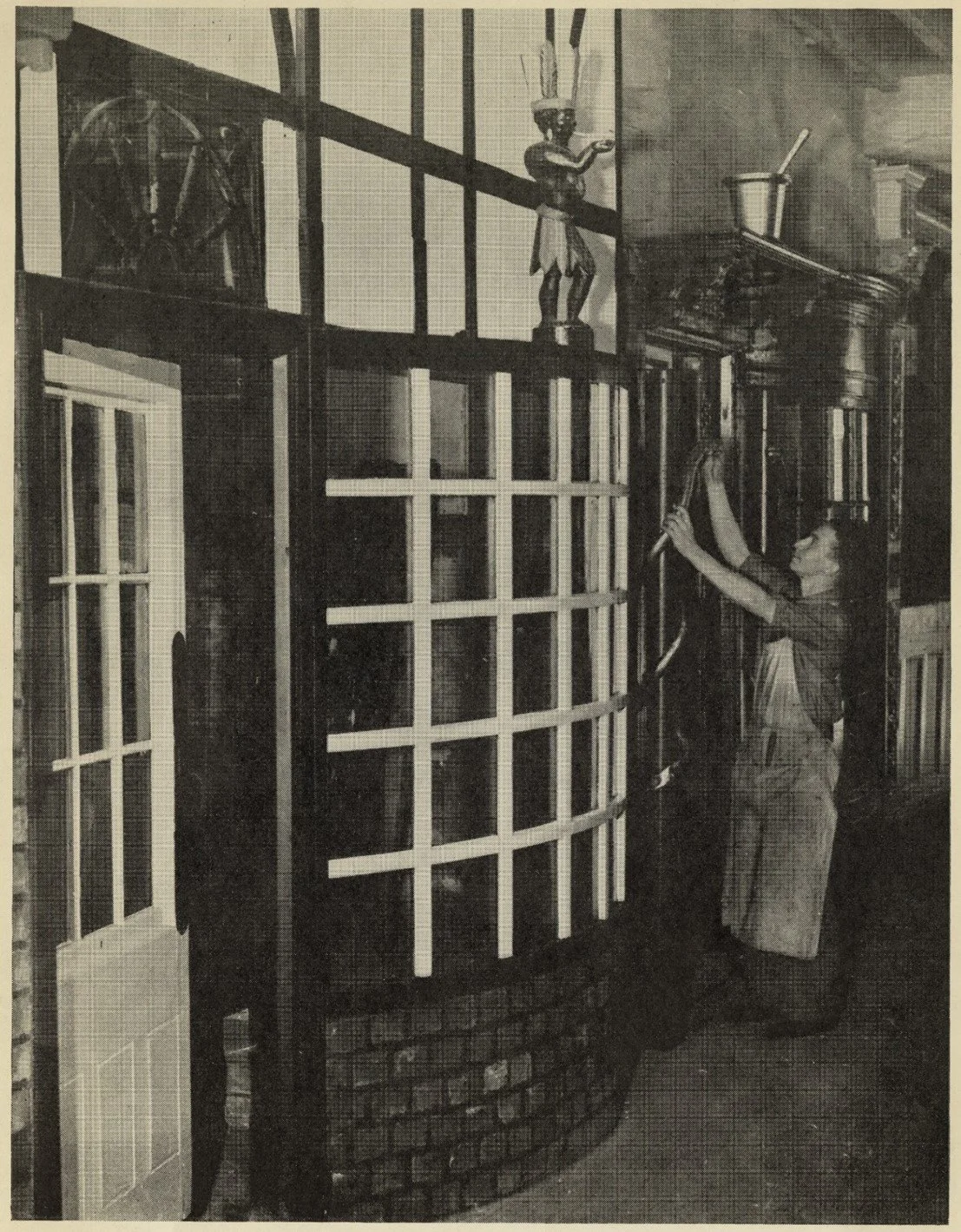
ELABORATE: The tobacconist shop, circa 1935
Tobacconist: With a window from York, the shop’s fittings came from Mr Pickering’s tobacco shop in Bond Street. Above the doorway was a statue of a boy with ostrich feathers and an original 1660s-style tobacco pipe which was purchased from the Battersby’s Museum at Paull. Inside were kilns, moulds and a large stone trough, used by Messrs Stonehouse, the last Hull tobacco pipe makers situated in Marlborough Terrace.
Gunsmith: The exterior showcased a large gilded gun smith sign from Robin Hood’s Bay. Inside were harpoons, pistols and other guns manufactured by George Wallis, the Hull gunmaker, including a gilded Blunderbuss and a double flint-lock whaling gun from the Hull whaler Volunteer.
Woodturner: This housed various wood carving and clog makers’ tools, as well as jet polishing and turning tools from Whitby. Furnishings were from buildings in Hull and Beverley from the Elizabethan to the Georgian periods. It had a working 18th century wood turning machine.
Blacksmith: This shop was largely the whole of Mr Moore’s shop on Holderness Road, a well-known craftsman of Hull at the time.

A WINDOW INTO THE PAST: The exterior of the plumber's shop, circa 1935
Plumbers: Housed from a semi-reconstructed frontage of Hull’s oldest building, the King’s Head Inn, which was pulled down from the High Street in 1905. The window was from Edwin Davis’s old drapery in Bond Street and inside was a large table, used to cast the lead for Beverley Minster. Cast iron window frames from the former Citadel could also be seen.
Hotel: Starting on the opposite side of the street were part of the frontage of the White Lion Hotel, formerly in Collier Street, which was pulled down in 1930. It was transported almost entirely and rebuilt inside the warehouse.
Mercers: Housing spinning wheels, tools for winding wool, a printing machine, old type, copper plates and lithographs, it was an example of a general merchant’s shop.
Antique shop: The catchall shop, within which many of the objects not suitable for the other buildings were housed.
Undertakers: This shop housed an elaborately carved Gothic hearse, the first made by Annison’s the Hull funerary parlour.
Organ builders/music shop: Inside this building was an old Gothic organ from Hedon Church alongside a collection of historical music instruments from Hull and other makers.
The last few buildings in the warehouse were a hatter’s and a bootmaker’s but little is known about these buildings. One of the larger pieces secured for the street was a six-windowed Georgian shop front acquired from Lewes.
Down the middle of the street was an early 18th century stagecoach from Exeter, a horse drawn carriage, an early motor car and a Driffield subscription fire engine built in 1840. The street itself was lit with whale oil lamps that came from Queens Dock and was adorned with an early Hull milestone, gallows and stocks.
The new museum was set to open in March 1939 and be staffed by people in period costume, a real blacksmith at work and beer being produced from the re-created inns. However, approval was still waiting from the Property and Bridges Committee in May 1940.
The next month saw the bombing raids in Hull begin and overnight on May 8-9, 1941, the city was subjected to a heavy bombing, including High Street.
John Colletta, a volunteer fireman, was credited with saving Wilberforce House and was awarded the George Medal; however, there was another that acted equally as heroically and went un-recognised.
The fire watchman at the museum, James Anthony, was first on the scene. He recalled that: “At Wilberforce House they dropped five incendiaries [he got to work to put them out] …After that they dropped a H.E. Bomb and it knocked me into the Doll’s House. I picked myself up and…started playing on the fire to keep it under control…[and] stop it breaking in at the top floor”.
After working on the fire for hours, just after midnight the city firemen arrived and five warehouses were ablaze, three on the west of High Street and two on the east. Colletta began attacking the fire at Ware’s warehouse in front of the museum. He soon found himself and Wilberforce House surrounded in flames.
With fires still raging Coletta moved to fight the raging inferno that was overtaking the warehouse behind Wilberforce House.
The firemen were called away at 2am due to further fires elsewhere but Anthony continued alone, until nearly 9am, by which point the fire which was subsiding began to take hold again. Anthony recalled that: “It was one large furnace all around. I have been in France but nothing like the night I went through.”
Although Wilberforce House was saved, Sheppard’s Museum was gone. He stated in his report that: “Our warehouse at the back, which contained the various shops and their contents, forming the ‘Old Street’, as well as the exhibits stored on the upper floors, was entirely burnt out, and practically everything destroyed, though we may retrieve a few objects from the debris. The roofless four walls are standing, and the 29…cast iron pillars supporting the floors are still erect…The wharf on the harbour side adjoining the warehouse, is burnt through, and cannot be used…”.
Sheppard retired in October 1941, as was the corporation’s policy. The warehouse remained a bomb site with the cast iron pillars, unsupported and at risk of falling into Wilberforce House.
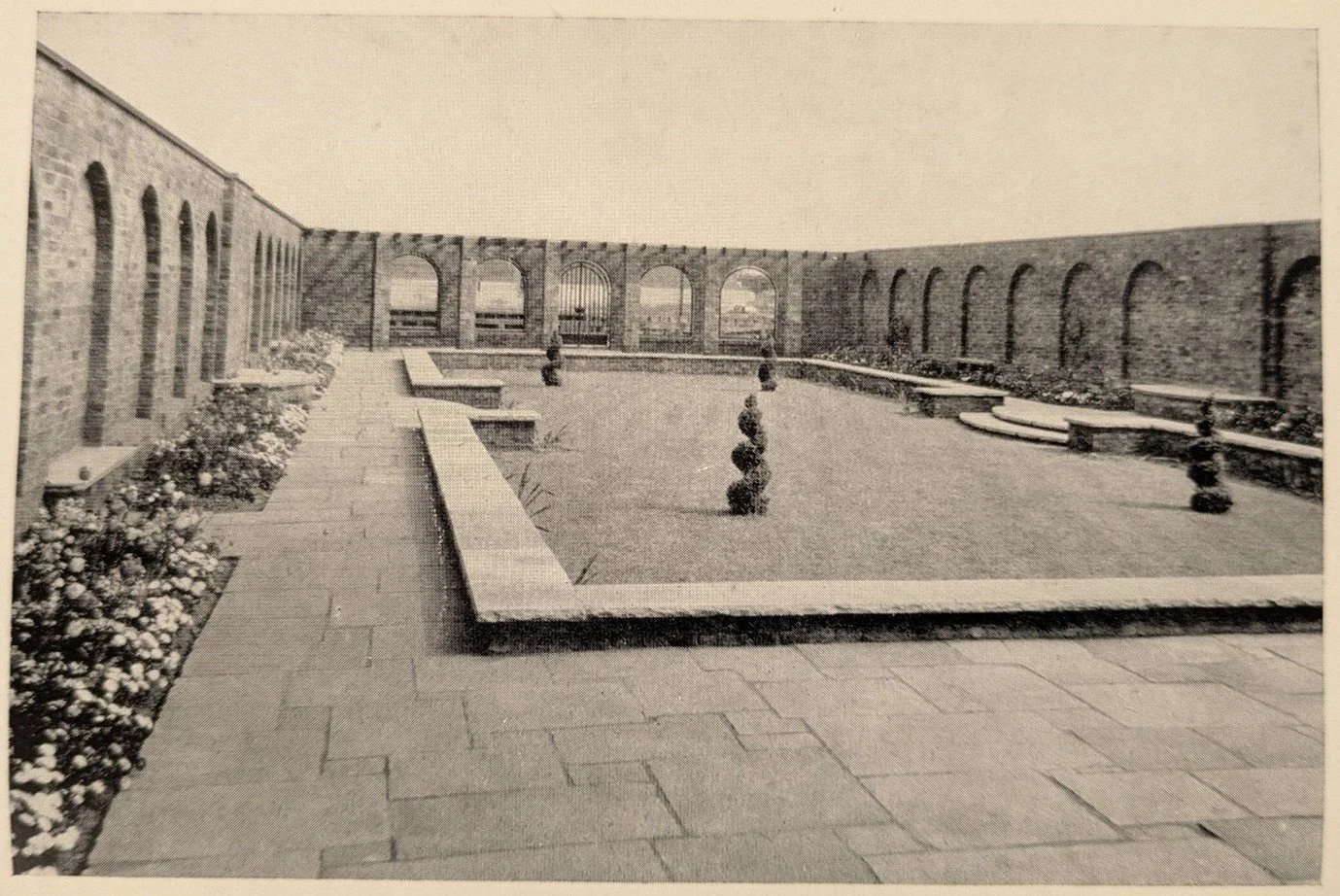
‘GREEN OASIS’: The Wilberforce Garden, which replaced Hull’s ‘Old Times’ Street, circa 1950
The following year work began on clearing the site and virtually nothing had been recovered. In July 1944 approval was given for the area, which was Hull’s ‘Old Times’ Street, to be turned into gardens for Wilberforce House.
In late 1949 the work had almost been completed using period bricks from bombed properties in High Street. The garden was described in 1950 when it opened as: “Arise[ing] from the former waste of bomb damage…it will be entirely in keeping with the historic house…Already the lawn and the fan shaped ornamental trees and climbers…look thoroughly established… [It is] a green oasis in the Old Town.” (Hull Daily Mail, April 15, 1950)
Sheppard’s last museum took almost a decade to complete, and although its loss means it was never seen by the public at large, you can find examples of it at the Streetlife Museum in Hull, the York Castle Museum and Kirkstall Abbey Museum.