
The truth behind Ye Olde White Harte and its Plotting Parlour

NOTABLE GAP: Hollar’s plan of Hull, 1640, showing the area where Ye Olde White Harte would later be built

The Way it Was
In partnership with Hull History Centre
By Neil Chadwick, archivist and librarian at Hull History Centre
The Ye Olde White Harte is an historic pub dating back to the second half of the 17th century.
Located between Silver Street and Bowlalley Lane (formerly Denton Lane) via a narrow passageway, it offers a glimpse into Hull's past, when ships docked along the river and almost all residents lived within the then walled town.
Whilst being well-known as a favourite among Hull’s pubs – a must if participating in the famous ale trail – Ye Olde White Harte has become known to many as the place where, in 1642, Sir John Hotham, the then governor, hatched a plot denying King Charles I entry into Hull. Many also believe this action led to the start of the English Civil War. And the rest, they say, is history!
Stop there. Whilst Sir John Hotham did indeed refuse Charles entry into Hull, the decision wasn’t taken in Ye Olde White Harte. The Plotting Parlour in Ye Olde White Harte has got somewhat confused with the actual plot hatched there some 46 years later.
The Plotting Parlour in fact takes its name from an event in 1688. In that year, on December 3, the Mayor, Aldermen, along with leading figures of the town gathered at what was then the deputy governor’s house, now Ye Olde White Harte.
They hatched a plan to overthrow Hull’s Catholic governor. It is this plot that the Plotting Parlour takes its name from, not that of Sir John Hotham’s refusal to admit Charles I into Hull.
Despite this, some continue to believe, and indeed strongly argue that the Plotting Parlour is where Sir John Hotham decided to refuse Charles I entry in 1642. So, owing to this confusion, we thought we’d put the record straight.
Please note, if you are one of those who believes Ye Olde White Harte is indeed the place where the plot was hatched to refuse Charles I entry into Hull, you may want to look away now…

POLITICAL CENTRE: An illustration of the Hull’s Guildhall, which may have been the place where the decision to deny Charles entry into Hull was made
The myth
The myth about Ye Olde White Harte being the residence of Sir John Hotham appears to have originated in the 19th century.
Despite many of its original features, the building underwent significant alterations in 1881.
Features like its stained-glass windows, which include the depiction of Sir John, only serve to enhance the myth, giving the impression of a time of Roundheads and Cavaliers.
Research carried out by Historic England reveals Ye Olde White Harte was not built until after the Civil War.
It was built by William Catlyn, for Alderman William Foxley, a wealthy grocer in 1660. Catlyn was a bricklayer in Hull and responsible for several buildings in the town, including Wilberforce House and probably Crowle House.
Catlyn himself is recorded in some of the documents here at the Hull History Centre.
Hollar’s plan of Hull
A clue to whether Ye Olde White Harte was around at the time of the English Civil War is perhaps revealed in Hollar’s plan of Hull of c.1640.
Looking in the vicinity in which Ye Olde White Harte is located, there is a gap or space where it sits today.
Firstly, this isn’t unusual. Gaps or spaces were common at this time in Hull. Despite being confined within its medieval walls, the town had open spaces, particularly close to its walls. There were even gardens.
We must of course recognise not every building in Hollar’s plan is accurate and must allow for some form of artistic licence.
This said, Hollar appears to have had a knack to illustrate places from a viewpoint, impossible before flight. He must also have had some intimate knowledge of the town.
Hollar depicts, for example, the busy river with most buildings lining High Street which for centuries was Hull’s commercial and economic hub. It was the River Hull or 'Haven' where ships loaded and unloaded their goods, whilst merchant houses and warehouses would have lined the river front and High Street. And Hollar knew this.
The Castle and Blockhouses on the eastern side of the river are shown in detail, whilst prominent landmarks such as Holy Trinity, the Kings Manor and the Guildhall all feature, though this is perhaps to be expected being the town’s most prominent buildings at the time.
Lister House, the forerunner to Wilberforce House, can also be identified. This begs the question, had Ye Olde White Harte supposedly been the Governor’s house, surely Hollar would have included this? Had it been around at that time, it would have been one of the larger and more impressive residences in the town.
Hollar had every reason to create accurate maps and plans. The demand for detailed maps was ever increasing. To military commanders, their value would have been a huge benefit, especially during the English Civil War, particularly whilst employing sieges against a town, including that of Hull.
Could the Earl of Newcastle, for example, have held in his possession a copy of Hollar’s plan whilst laying siege to Hull? There is no doubt the value of Hollar’s work is certainly in the detail.
HISTORIC: A late 19th century illustration of Ye Olde White Harte by Tindall Wildridge
‘Plot’ and refusal to admit Charles I into Hull
Whilst Sir John met with Peregrine Pelham MP and several Aldermen, the decision not to admit Charles was likely made in the Guildhall or the Kings Manor (the old de la Pole manor, later Suffolk Palace on the site of what is now the Three John Scotts pub).
Since at least 1333 the Mayor, Alderman and Burgesses of the town met at the Guildhall (not the Guildhall we see today, but the building that once stood at what is now the junction of Lowgate and Mytongate, close to the King William statue).
It was here that decisions were made concerning the town’s governing. Prisoners were tried and imprisoned here. High Street may have been the economic hub of Hull, but it was the Guildhall that was the political centre of the town.
And whilst the refusal by Hotham was a blow to the royalist cause, things between Parliament and Charles were already fractured. Therefore, civil war was almost inevitable at the time Charles was refused entry into Hull.
On August 22, Charles raises the Standard at Nottingham and declares war on Parliament, and the English Civil War begins.
Was Sir John’s decision not to admit Charles a plot, as such? Sir John was appointed governor by Parliament and to act on its instruction. The decision to refuse Charles I entry was that of Parliament.
Sir John, the Mayor and Aldermen together with Parliament knew Charles wasn’t coming to Hull to sightsee, nor was he nipping in for a quick cuppa and a catch-up with old friends. He was coming to Hull for one reason and one reason only. That was to secure the town’s arsenal, which outside of London was the largest in the country.
Being a trading port with connections to northern Europe and beyond, Hull would have provided Charles with a secure port to land men and supplies, should war be declared against Parliament.
Sir John Hotham and Charles I
Sir John had personal reason not to admit Charles.
Beef had existed between the two men going back to 1640 when Sir John was removed from his first post as Governor of Hull by Charles following repeated conflicts over ship money.
Charles also threatened Sir John with hanging if he continued to oppose the Second Bishops War with Scotland in late 1640.
Mindful of this, Sir John knew the personal risk of admitting Charles into Hull, which could have easily ended with his execution.
This feud between Sir John and Charles wasn’t exactly secret, and this would have been known to Hull’s Mayor and Aldermen. This, along with Sir John’s orders from Parliament, would have hardly been a secret.
Whilst the Mayor and Aldermen were in the know, the refusal to admit Charles may have been on a who needs to know basis prior to his arrival. The everyday townsfolk may have been unaware of what was to unfold on April 23, 1642.
Some argue Sir John was somewhat undecided on his loyalty. He was, after all, ready to switch sides to the King in 1643 because of his deteriorating relationship with Parliament due to its reluctance to provide money to garrison Hull. However, there was little to suggest Sir John was sat on the fence in 1642.

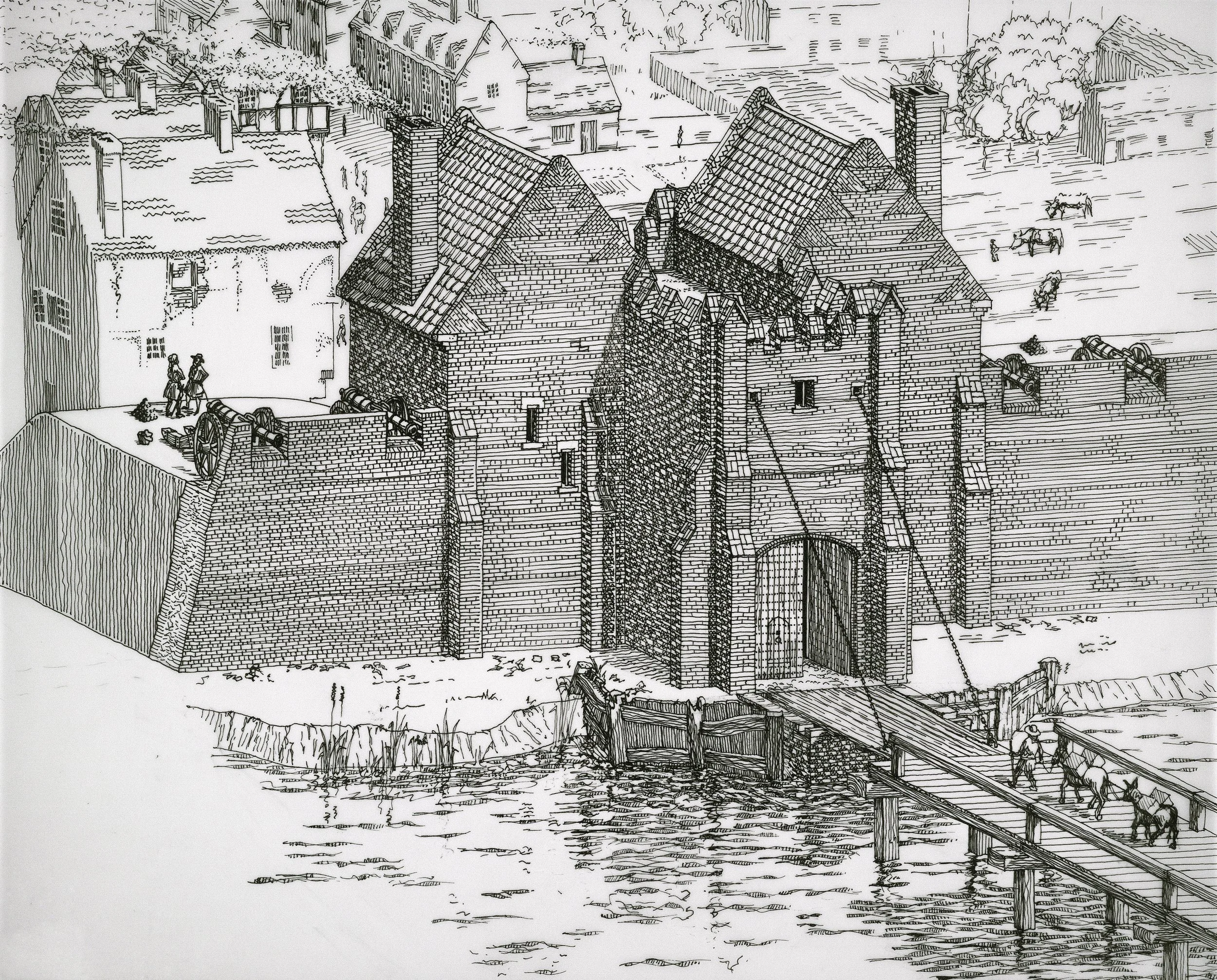
LONG GONE: A sketch tracing of Beverley Gate of how it may have looked in 1642
1688 Plot
In 1688, things were different.
The town’s Catholic Governor was planning to arrest Hull's Protestant officers and soldiers. To turn the tables against Hull’s Catholic governor, a plot was hatched.
This plot was devised in the deputy governor’s house (now Ye Olde White Harte) by Hull's leading Protestant figures in their support for the Protestant William of Orange. But for it to succeed it had to be done in secrecy, whereas 46 years earlier, Sir John's intentions not to admit Charles were less of a secret.
This, and the fact Ye Olde White Harte was yet to be built, means the Plotting Parlour relates to the plot of 1688, not the plot of 1642.