
The De la Poles: The real-life Game of Thrones

INFLUENTIAL: Illustration dated c 1884 of De la Pole house on High Street, built by William and Richard de la Pole in the 14th Century

The Way it Was
In partnership with Hull History Centre
By Neil Chadwick, archivist/librarian
The crown of England has always been a valuable prize. Claimants have been willing to put their life on the line to defend it, claim it and conspire to overthrow it.
There has been a long line of claimants, whether it be Harold Godwinson and William the Conquer in the 11th Century, Stephen and Matilda during the Anarchy of the 12th Century, Louis of France in the 13th Century, Henry Bolingbroke and Richard II in the 14th Century or the Houses of Lancaster and York in the 15th Century.
The 15th Century was a particularly turbulent time, a real-life Game of Thrones (minus of course the dragons and the white walkers!). It was a period when the houses of Lancaster and York fought for the right to rule the green and fair pleasant land of England. Deposers, murderers and usurpers all featured as rivals fought against one another for the coveted prize.
Perhaps the most infamous grab came in 1483 when Richard Duke of Gloucester is reputed to have had his nephews, the two princes, killed in the Tower.
Richard’s reign was short-lived. His death at Bosworth in 1485 gave rise to the Tudor dynasty, and with it the Yorkist claim to the crown was all but extinguished.
Whilst the Tudors were successful in eventually staking their claim to the crown of England, they faced threats. Perhaps the most well-known was from Lambert Simnel and Perkin Warbeck.
Warbeck was executed, whilst Simnel managed to avoid the executioner. It is reputed that he (Simnel) served as a spit-turner in the kitchens and later a falconer to Henry VII, before dying sometime after 1534.
The De la Pole claim to the English crown came via the House of York. Elizabeth, mother to John, Edmund, Richard and William de la Pole was the sister of Edward IV and Richard III.
But with Edward IV dead, his male heirs (the princes) murdered and Richard dying without a surviving heir, John, Edmund and Richard de la Pole were thrust into the light.
The De la Poles are a household name in Hull. The first De la Poles were William and Richard. Whilst their origins are obscure, both William and Richard were merchants in Hull after Edward I granted the town’s Royal Charter in 1299.

HOUSEHOLD NAMES: Letter dated c 1450 from John de la Pole 1st Duke of Suffolk
Both William and Richard went on to climb the social and political ladder of the 14th Century. In William’s case, more so. He was Hull’s first mayor but also became Baron of the Exchequer during the reign of Edward III, becoming chief money lender to Edward for his war with France.
Henry Tudor’s claim came through the House of Lancaster, via John of Gaunt, the fourth son of Edward III.
Despite being from the opposing houses of Lancaster and York, John de la Pole and Henry VII were in fact cousins via the Beaufort line. Between the two houses, York had a stronger claim to the throne.
While Henry Tudor descended from the fourth son of Edward III, John de la Pole descended from the third son of Edward III. Despite the efforts of Henry Tudor to legitimise his claim over the House of York, even marrying Elizabeth of York, daughter of the late Edward IV, the De la Poles still posed a threat to Henry and future Tudor successors.
During the reign of his uncle Richard III, John de la Pole seems to have been designated Richard’s heir, though this was never publicly claimed. Richard III’s only son, Edward, died in 1484. John’s uncle, the late Edward IV, made him Earl of Lincoln in 1467. After Richard’s defeat at Bosworth in 1485, John reconciled with Henry Tudor. John, however, soon became impatient with the new Tudor regime.
He became leader of the Yorkists claim to the crown of England and travelled to Burgundy to persuade his aunt Margaret, Duchess of Burgundy to finance a military expedition to take the throne from Henry. And with an army of mercenaries, supported by Gerald FitzGerald, eighth Earl of Kildare, he sailed to Ireland.
John crossed the Irish Sea and landed near Barrow-in-Furnace before marching to York. York was a former stronghold of the late King Richard, and John felt that as the nephew of York’s favourite son, the city would welcome him with open arms.
York’s citizens, however, refused to admit him. John quickly moved on. He scored small victories over Henry’s forces at Bramham and Lincoln but avoided the main northern army of Henry.
On June 16, 1487, John’s luck ran out. By now the vanguard of Henry’s army caught up with John and the Yorkists at Stoke Field. A battle ensued and the Yorkist army was convincingly defeated, and with it, John de la Pole was killed.
John’s death didn’t end the Yorkist claim to the crown though. John had a younger brother, Edmund.
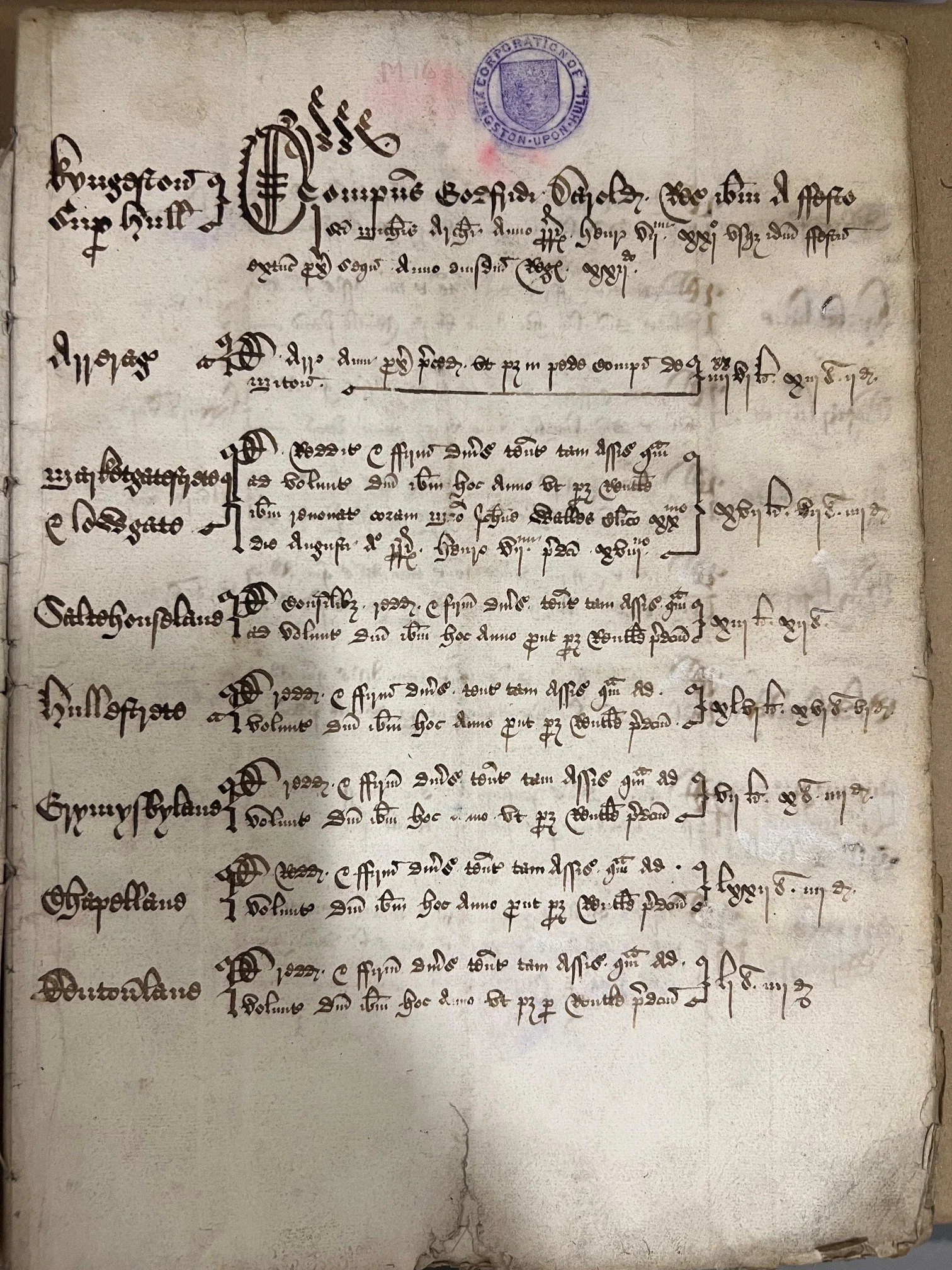
ROYAL CLAIMS: An extract from the account of Godfrey Darold of the De la Pole estates in Hull held by the King (Henry VII) in 1506-07
After the death of John, Edmund de la Pole now became the leading Yorkist claimant. Like his brother John, Edmund appears to have got on somewhat well with Henry at first.
Henry granted him £5,000 for a portion of the lands forfeited by his elder brother after his death at Stoke Field in 1487. And despite being indicted for murder in June 1497, Edmund was pardoned in July 1499. After his pardon, Edmund fled overseas, but returned in September that same year, ‘stout and bold and of courage’.
In August 1501, he again left England, this time with his younger brother Richard. Henry accused them of plotting against him. Both Edmund and Richard joined up with the Emperor Maximilian, and it was here that Edmund assumed the title as Duke of Suffolk. For this, and the alleged plot against him, Henry outlawed Edmund.
Edmund attempted to join up with the Duke of Saxony but was imprisoned by the Duke of Guelders and later Philip of Burgundy. Edmund was turned over to Henry Tudor and committed to the Tower in 1506.
Edmund remained in the Tower for seven years. His brother, Richard, was still loose on the continent, joining the service of the French with whom England was then at war.
For Edmund, it was the end of the line. He was beheaded on Tower Hill on April 30, 1513, aged 42. Upon hearing the death of Edmund, Richard de la Pole declared himself Earl of Suffolk and became the third brother to lead the Yorkist claim.
A year after the death of Edmund, Richard set about to reclaim England. He was stationed in Brittany with 12,000 mercenaries. Unfortunately for Richard, England and France had just made peace. The planned invasion was called off.
But in 1523 the invasion was back on. Richard struck up an alliance with Francis I of France. The invasion, however, never happened. Two years later, Richard was killed fighting at the Battle of Pavia. And with that, the De la Pole and Yorkist claim to the crown was all but dead.
Unlike the later Tudors, notably Henry VIII, the De la Poles were blessed with boys. They had a fourth son, William de la Pole. Unfortunately for William, he was captured by Henry VII in 1501 when his two brothers, Edmund and Richard had fled to the continent to push the Yorkist cause.
It may be that William had little interest to advance his, or his brothers claims. He remained in England, suggesting perhaps his innocence, but this did little to dissuade Henry from moving against him.

THE HOUSE OF HULL?: An extract from the copy of a grant from Henry VIII to Sir William Sydney of the estates of Edmund de la Pole in Hull and Myton in (1512)
William spent the next 37 years locked up in the Tower, the longest prisoner in its history. It was here that William died in 1538. And with it, the Yorkist attempt to re-claim the crown was dead.
The Yorkist claim ended with the death of Richard de la Pole in 1525, as William by this point had already been imprisoned in the Tower for 22 years. Added to this, John de la Pole had no children. Edmund had a daughter, but she died of plague in 1515, and despite Richard also having a daughter, she was illegitimate. The last De la Pole claimant, William, locked up for 37 years, had no children.
If that is not enough, the De la Poles’ grandfather, Richard, Duke of York, also made a play for the throne before his De la Pole grandsons. Richard, however, was killed when a Lancastrian army defeated the Yorkists at the Battle of Wakefield in December 1460.
But as we’ve just seen, the Game of Thrones continued, of which the De la Poles were at the forefront in the later 15th and early 16th Centuries.
Had history played out somewhat differently, the House of Hull – the De la Poles that is – may have sat on the throne!