
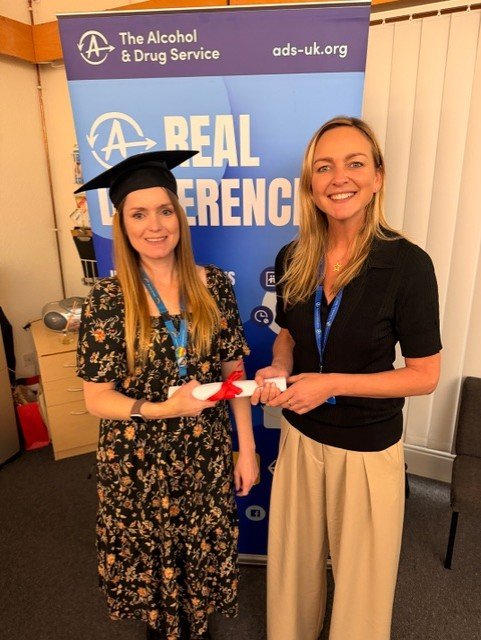
PROUD: Kirsty Young, left, and Kate Taylor
By Rick Lyon, Co-Editor
A recovery worker has become the first employee at The Alcohol and Drug Service (ADS) to complete a social work degree apprenticeship through its investment in staff development.
Kate Harvey completed the three-year programme at the University of Hull while balancing a full-time job, academic study and two work placements.
Her achievement brings to fruition an ambition ADS began discussing in 2013. Six further apprentices are due to graduate over the next three years.
Rather than recruiting externally to a dedicated apprenticeship post, ADS opened the opportunity to all existing employees to support career development and strengthen skills within its services.
The programme also supports ADS’ ambition to help professionalise the recovery sector and champion social work’s contribution.
Kirsty Young, quality and performance director and principal social worker at ADS, said: “We made a deliberate decision to grow our own talent. Rather than recruit someone into a specific apprenticeship post, we wanted to invest in the people already working with us and make the opportunity available regardless of grade.
“Our colleagues bring valuable experience, insight and commitment to recovery work. Supporting them to develop further is an investment in their futures and in the quality of support we provide.
“Seeing Kate become the first to complete the programme is a hugely proud moment.”
Kate joined the East Riding Partnership after taking a career break to raise her children, bringing experience in mental health and health and social care.
As an in-reach support worker, she supported people experiencing homelessness or involved in the criminal justice system, helping them access healthcare, manage bills, develop everyday living skills and prepare for employment.
For Kate, building relationships is central to recovery work. She described supporting a couple who had experienced homelessness for many years and initially did not want help. Through two years of support and coaching, they became more settled and independent.
“Now they are supporting themselves, they are stable, living in their own property and considering volunteering opportunities,” she said.
“As social workers at ADS, we are given the gift of time. Without that time, it would be a completely different job.”
Kirsty said: “Recovery is about understanding the whole person, not seeing someone only through their alcohol or drug use.
“Social work brings an understanding of people’s circumstances and rights, alongside professional judgement, advocacy and practical support.”
During her studies, Kate shared her experiences with potential apprentices.
“You’ll gain real skills – not just academic knowledge, but practical, life-changing ones,” she wrote. “This job is hard, but the impact you have is real.”
Kirsty praised Kate’s determination and the colleagues who supported her, particularly Ali Haynes, Liz Hartley and her mentor, Paul Martindale.
“Kate’s achievement shows what investing in our own people can make possible,” she said.
“With six more colleagues following this pathway, we are building lasting opportunities for our staff while helping strengthen professional practice across the recovery sector.”
Kate is preparing to begin her Assessed and Supported Year in Employment (ASYE), with her university graduation ceremony expected in January.
Encouraging others to consider recovery services, Kate said: “For anyone out there who doesn’t know what they want to do, the opportunities are there. There is lots of training and support. Drug and alcohol services really do want people to come and work for them.”