
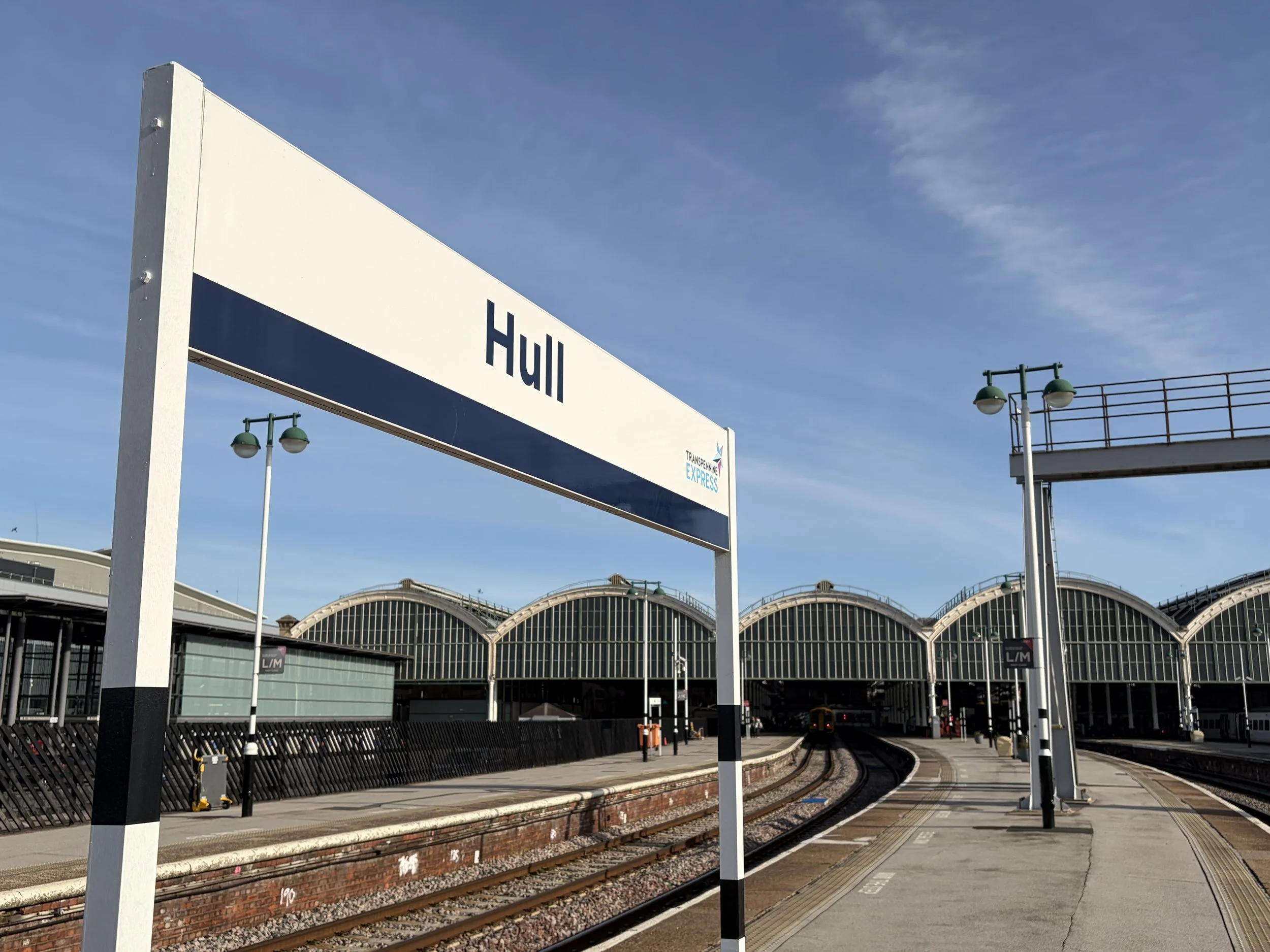
‘HELP US FINISH THE JOB’: Hull MPs are urging First Hull Trains and Northern to follow TransPennine Express by investing in new battery-electric trains. Picture: Paragon Station
By Hull MPs Diana Johnson, Emma Hardy and Karl Turner
Remember, remember the 16th of November…
Ten years ago today, Humber MPs received a letter from the then Tory Rail Minister informing us that the Government was blocking the scheme supported by First Hull Train to electrify rail lines to Hull.
After three years of cross-party working by Humber MPs, local authorities and the Humber business community to lobby for this scheme, the decision came as a brutal setback for our aspirations to improve Hull’s rail connectivity.
Despite much talk in the 2010s about ‘levelling up’, Hull was left out in the cold – again.
Hull’s prospects did not improve for some years after that. Five years ago, in November 2021, Hull rail electrification was effectively ruled out for decades more in the Integrated Rail Plan.
Needless to say, electric trains are the norm in London and the South-East.
Also in the 2010s, the catastrophic mismanagement of the HS2 project, which saw its costs double from £37.5bn at the start of that decade to £98bn by its end, resulted in the cause of genuine high speed rail travel in the UK being set back. In October 2023, Prime Minister Sunak then cancelled the Northern leg of HS2. The surviving stretch from West London to Birmingham saw its speeds downgraded from those originally planned.
The harsh reality is that the vast majority of the UK will not now see the vision of all-out high-speed electric ‘bullet trains’ – possibly for decades. In that respect at least, Hull is not being discriminated against.
In justifying his decision to cancel HS2 reaching the North, Rishi Sunak claimed that the money saved from cancelling the Northern Leg of HS2 could be used for other transport projects – mentioning Hull electrification. This claim was soon clarified as being only “illustrative”. In the event, supposed savings were notoriously diverted to mending potholes in London!
It has been pointed out that electrification of rail routes to Hull was in the Hull and East Yorkshire Devolution Deal that the two Council leaders signed up to early in 2024.
It came with up to £15m of Transport capital funding for 2024/25 and a long-term investment fund for Hull and East Yorkshire of £400m spread over 30 years – around £13.3m a year.
The cost of the rail electrification scheme for Hull that was blocked in November 2016 was some £100m – even at 2013 prices.
There was clearly a need to attract private investment and this was one of responsibilities devolved to Mayoral Combined Authorities. It is unclear what Mayor Luke Campbell has done on this over the past 18 months.
Alongside the rollcall of bad news for Hull in the past decade, there has been one positive development. Advances in battery-electric technology in the rail industry have radically reduced the upfront capital costs of rail electrification, compared to ‘traditional’ electrification based on continuous overhead cables – as in the scheme we saw blocked in 2016.
Installing the required charging infrastructure in Hull and at key points across the North would allow battery-electric trains from all operators to bridge the gaps between stretches of the network that will have overhead cables. The vision of a fully-electrified rail network, stretching coast-to-coast from the Humber to the Mersey, is now within reach.
In September, TransPennine Express grasped this opportunity with their announcement of their £1bn investment in a new fleet of 29 battery-electric trains, to enter service in 2034. This will benefit the whole of Northern England – including Hull – and build upon the Northern Powerhouse Rail announcement that the Government made in January.
This was a breakthrough in the long cross-party campaign by Humber MPs, local authorities and the business community to secure rail electrification for Hull. Now we are asking First Hull Trains and Northern, the other rail operators serving East Yorkshire, to help us finish the job on full rail electrification by announcing as soon as they can that their new fleets for the 2030s will also be bimodal battery-electric.
Ditching diesel is also about national security – cutting our exposure to global fossil fuel price shocks. The much-reduced outlay on infrastructure would be followed by reduced running costs, hopefully taking pressure off ticket prices.
Given that continuous overhead cables are notoriously prone to storm damage, battery-electric traction would also mean a rail network less vulnerable to disruption and more resilient in the face of the more frequent volatile weather that climate change is bringing. Rail users around Hull would certainly appreciate a rail system more resilient to seasonal factors! The process of installing charging infrastructure for battery-electric trains would also involve less service disruption than the works to install continuous overhead cables.
Above all, battery-electric bi-modal trains for all of the North would realise the full benefits of faster speeds across the network. This was always the main point of our campaign for rail electrification. The speeds achieved by battery-electric trains are comparable to those running on continuous overhead cables. Both categories are faster than diesel, if not as fast as the ultra-fast Japanese bullet trains or the French TGV.
Faster trains would open up network capacity, creating scope for new timetable passenger services across Northern England – for example, train services from Hull to destinations such as Manchester Airport and Liverpool. As Hull is a port city, extra capacity is needed for freight too.
Competitive pressure on track access has been a particular concern for open access rail operators such as Hull Trains, who have provided Hull’s direct link to London for the past 26 years. Increasing rail network capacity would help ease that pressure.
Precise journey times between places such as Hull and Leeds are not just about the speeds that the trains can accelerate to, but also factors such as the number of timetabled stops on the route. The average distance between stations on the Hull to Leeds route is around seven miles. Meanwhile the distance between stations served by Japan’s Shinkansen bullet train network is between 31 and 49 miles – distances that facilitate the high speeds of up to 200 mph.
The choices made in ordering new train fleets for the 2030s and beyond must also mark another step towards a cleaner, greener public transport network – cutting carbon emissions and improving air quality.
We are particularly concerned about the continued operation of diesel-powered trains at Hull Paragon Station. As a largely enclosed space, the presence of carcinogenic diesel exhaust emissions affects air quality for station users and is a real public health issue.
England’s Chief Medical Officer Professor Chris Whitty recently reiterated his view that diesel should be eliminated from the rail industry, saying: “I cannot understand why we still allow diesel engines to idle in stations in this country just to keep the lights on, when there is a power source three metres away. It is ridiculous. Old diesel engines in enclosed spaces with large numbers of people working, commuting and going on leisure trips is an example of how to increase air pollution.”
The Department of Transport’s recent Rail air quality statement made the same case.
New train fleets potentially operate for decades. For that reason, we need decisions now that the use of diesel will end – not continue for years more, as would potentially happen with tri-mode or ‘last mile’ battery-diesel trains.
The advances in connectivity and public health that full electrification would bring for our constituents, to rail operators in lower financing and running costs and to the North in economic productivity and growth, makes the case for doing so beyond any doubt.
With the Government stating recently that further improvements to the £45bn Northern Powerhouse Rail scheme would be possible when other funding sources are secured, and noting the role that devolution is meant to play in this, the key task for us now is to continue working cross-party and with our business community to build upon the £1bn TransPennine Express investment.
Meanwhile, those who served in the 2010 Coalition Government, with the very same Tories who ten years ago today actively blocked Hull rail electrification, should cease the sniping about the progress that is now being made – including the investment from TransPennine Express.
We should all instead focus on making sure that Reform UK never get the chance to carry out their policy of scrapping Northern Powerhouse Rail entirely.
In encouraging the sort of public and private investment for the North’s transport infrastructure that Londoners have taken for granted for decades, all of us in the mainstream can agree that Hull and the Humber should get the same modern standard of electric trains as is being proposed for the latest rail schemes in the South of England – such as the planned Oxford to Cambridge link.
For the record, the Oxford and Cambridge rail link will be achieved through battery-electric trains.
Dame Diana Johnson is the MP for Hull North and Cottingham, Emma Hardy is the MP for Hull West and Haltemprice, Karl Turner is the MP for Hull East