

NEW MODEL: Employees can have an annual health check at the Hull Resilience Hub
By Rick Lyon, Co-Editor
A Hull company has launched a health hub to help small businesses tackle long-term employee absence and prevent people leaving work through illness.
Latus Group established the Hull Resilience Hub at its Chanterlands Avenue headquarters in July and is now being supported by Hull City Council to encourage more employers to take part.
The service gives small and medium-sized businesses access to workplace healthcare that many would otherwise struggle to afford, including GP appointments, physiotherapy and counselling.
About 1,000 employees have already been enrolled, with Latus hoping the Hull pilot will demonstrate a model that could be adopted across the country.
Jack Latus, chief executive of Latus Group, said: “We realised that a major part of the problem was that smaller businesses didn’t have access to healthcare through work. The biggest barrier was cost.
“Our mission was to create a service that cost SMEs less per employee, per year than large companies were paying. By bringing businesses together through a regional hub, we can make that support accessible.”
The initiative comes against a backdrop of growing concern about the number of people leaving employment because of ill health.
Keep Britain Working, the national review led by Sir Charlie Mayfield, puts the number of people economically inactive because of ill health or disability at about 2.8 million, around 800,000 more than in 2019.
Its September 2026 update estimates that health-related economic inactivity costs Britain about £212bn a year, including lost output and health-related benefits.
The research also highlights the importance of intervening early. Employees absent for four to six weeks have a 96 per cent chance of returning to work, but fewer than half return after more than a year away.
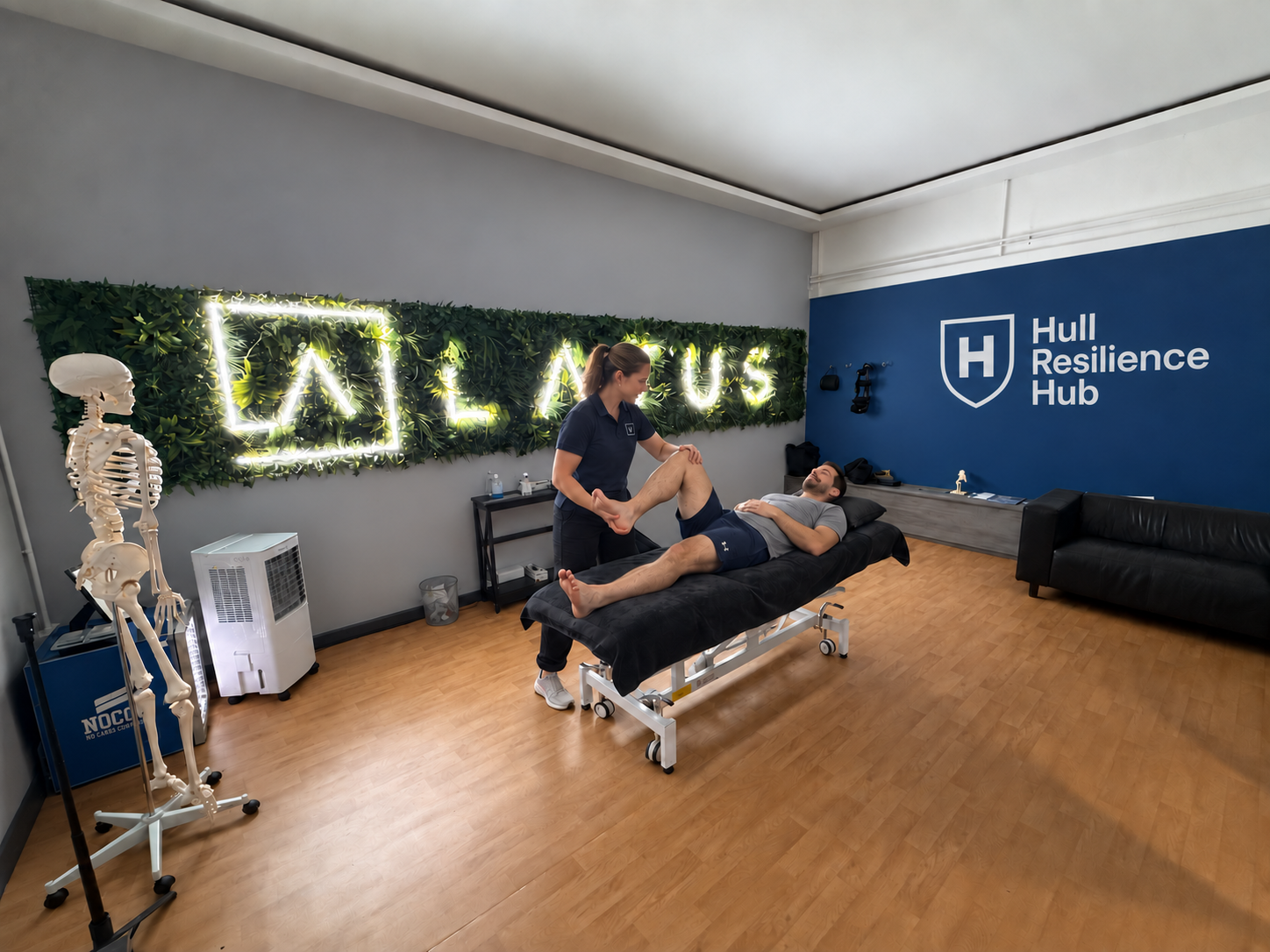
SUPPORT FOR SMES: Healthcare including GP appointments, physiotherapy and counselling is available at the Hull Resilience Hub
Latus Group estimates that ill-health absence and its associated effects cost SMEs across Hull and East Yorkshire about £200m annually, through lost working days, replacement cover and reduced productivity.
The hub aims to address both delays in accessing treatment and health problems that may be developing while someone is still working.
Alongside clinical appointments, employees can have an annual health check and complete a health questionnaire every six months. Where the questionnaire identifies a concern, a clinician can contact them directly to offer support.
Occupational health advice and return-to-work support are also included, helping businesses understand how employees can remain in their roles or return safely following illness.
Jack said: “We’re trying to pick up problems early, when someone is starting to struggle, so we can help them and keep them at work.
“That’s what the proactive questionnaire is designed to do. We don’t want to wait until somebody has been off for months before they get the support they need.”
Employers receive aggregated, anonymised information about their workforce, rather than employees’ individual questionnaire answers.
Latus says 65 per cent of enrolled employees have engaged by completing the survey, while 19 per cent have already accessed a clinical service.
However, Jack said it was too early to establish the hub’s impact on sickness absence. The pilot is expected to run for 12 months, allowing the company to collect evidence about its effectiveness.
“We’re in the data collection phase at the moment, and what’s important is that employers in Hull get involved,” he said.
“The engagement has been sensational, but we need enough data to show whether the model has been a success.”

PIONEERING: Jack Latus, chief executive of Latus Group
Founding members are being offered six months’ free access, followed by a charge of £50 per employee each year covering the healthcare services.
Businesses with as few as two employees have joined, alongside sole traders, for whom being unable to work can immediately affect their income.
Jack approached council leader Councillor Mike Ross after developing the hub, seeking a partnership to help reach employers across the city.
“The council has been really supportive,” he said. “They’ve been promoting it and taking it out through their networks. They’ve been fantastic.”
Coun Ross said: “While workplace health issues are a national issue, they are felt acutely here in Hull. As a council, we want to support the local business sector to be able to succeed – having a fit workforce is vital for that task.
“When Jack approached us with this proposal, it felt right for the council to back it and help support the small and medium-sized businesses through it. A thriving local economy is important for the strength of the city, but it is also the case that a supported local economy is one that sees benefits for the individual employees as well.
“They will be able to contribute more to the business but also feel happy and healthier at the same time. It is a real ‘win, win’.
“I would encourage anyone in business here in the area to get on board and see if the Hull Resilience Hub is the right fit for you.”
The Hull scheme is identified in Keep Britain Working’s September update as a test of whether pooling smaller employers’ buying power can give them access to occupational health services at prices available to large companies.
Jack founded Latus Group with his brothers Will and Sam in 2017. It now employs more than 350 people, including about 70 at its Hull headquarters, and serves more than 5,000 customers annually.
He said: “This is potentially a local solution to a national problem. We believe this is the model, and we want to prove it here in Hull.”
Businesses can find out more and register at https://latusgroup.co.uk/resiliencehub/