
Kath’s Jungle Diary: Talking to turtles and avoiding large scorpions – a night walk near the rescue centre
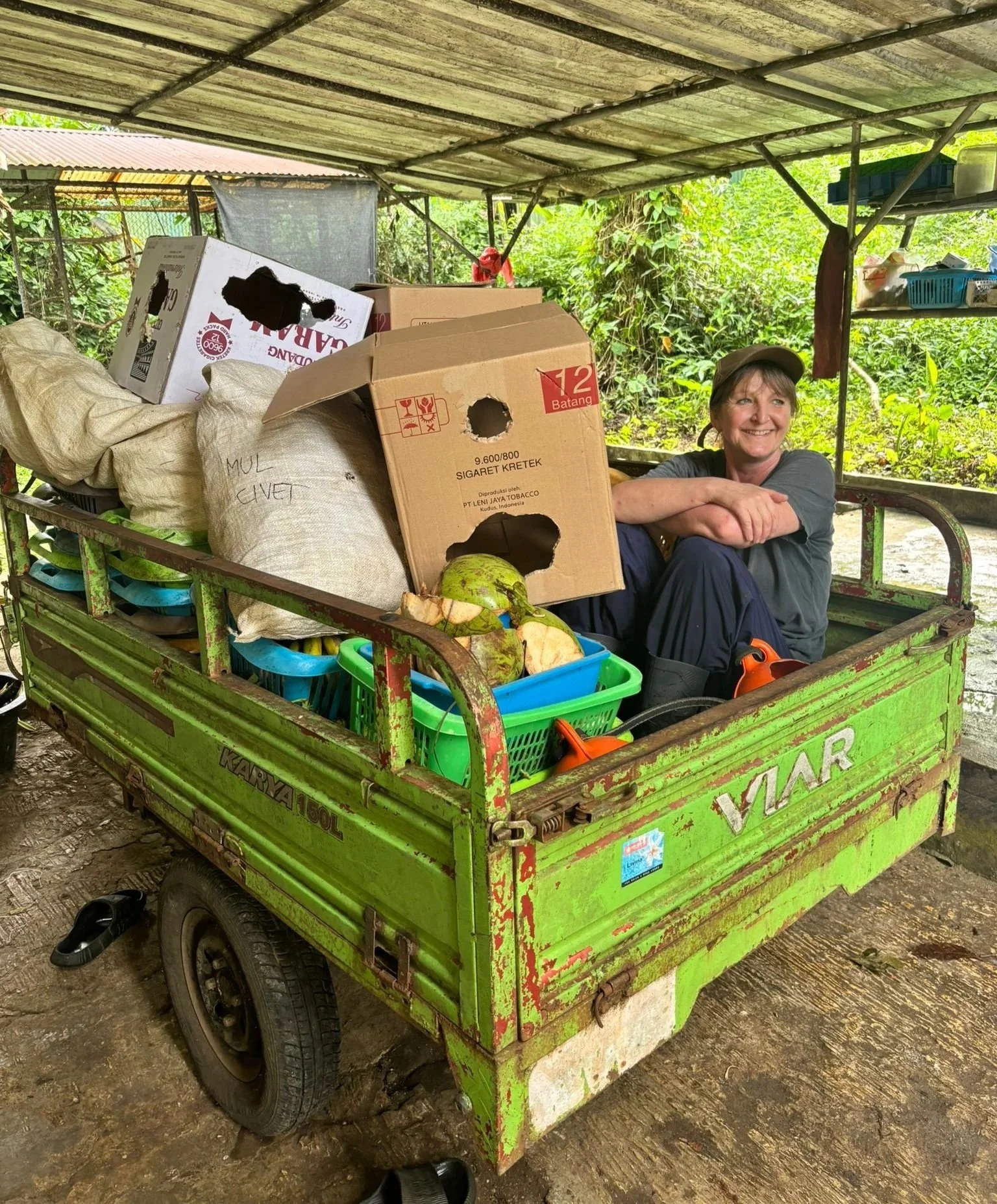
SUPPLIES: Kath on a trailer loaded with food for the animals
Kath Roe, a veterinary nurse from Beverley, is on a month-long internship at a wildlife rescue centre in Indonesia. She is writing about her experiences exclusively for The Hull Story
WEEK 2
My arrival coincided with the other volunteers and interns finishing work and some were chatting outside the dorm, wearing wellies and sweat.
I enthusiastically shook everyone’s hand then laughed about ‘how very British’ that was of me. They’re a young, mixed bunch. Five Dutch lads, all very tall, around 20ish (I can’t tell anymore, the youth all blend into ish), three of them here for three months studying and two young pups travelling on a gap year who’ve come for a couple of weeks of fun with the animals.
A German vet student is just finishing the internship I’m starting. She’s leaving tomorrow. Another, rather serious looking, vet student from Denmark had arrived two days before me. She’s thankfully turned out to be not that serious at all. I was shown the all-important ablution areas by a 30-something volunteer who’s a riding instructor from France; she’s returning home at the end of the week, and introduced to another Dane, also very tall, 30-ish, doing his PhD in something very scientific and complicated to do with soil and married to a drag queen in Nottingham (I immediately feel we will become firm friends).
The dormitories, one male, one female, are large wooden cabins on legs, with partitioned rooms containing a bed, cupboard and washing basket. It’s a bit like sleeping in an upmarket racing stable. Curtains can be pulled across for a certain amount of privacy but I fear someone was slightly out with the measurements as, like a changing room in a clothes shop, there’s always a couple of inches missing either side.
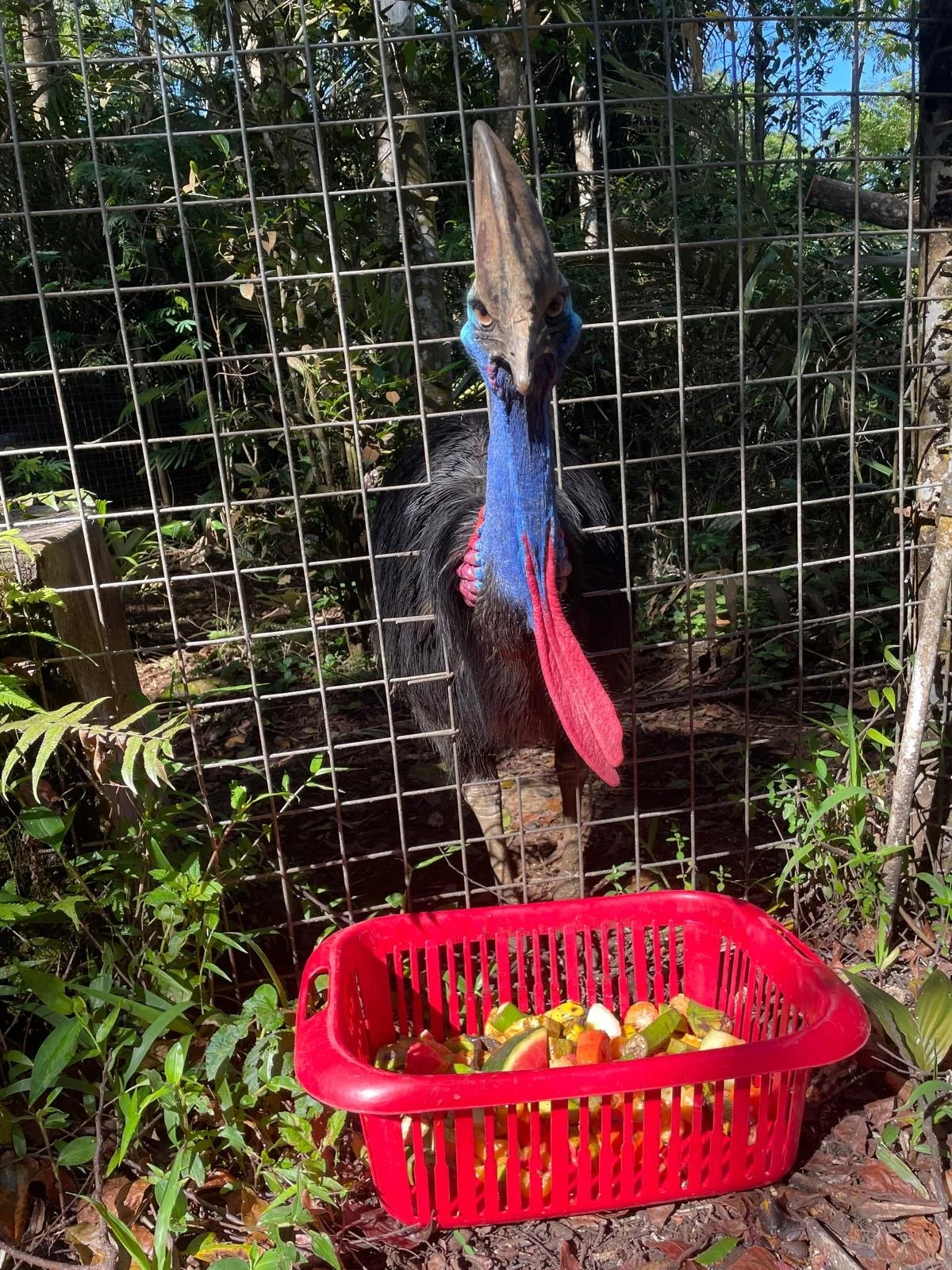
‘MAJESTIC FIGHTING BIRD’: The giant chickens, or Cassowaries, Kath feeds can kill people
I unpack. I like to unpack fully where ever I stay, makes me feel at home. Cue the sound of many zips and the rustling of bags as I suitably arrange my cupboard and put snacks (mostly old lady nuts and seeds) in the plastic storage box provided, to be taken to the kitchen.
Everyone usually gathers in the canteen after work. A large wooden (in fact, to save time, assume everything I mention is made of wood, unless otherwise stated!) platform overlooking the rice paddies and nearby mosque. Up some wide steps I’m pleased to discover the small, tiled kitchen contains, Lo! a large fridge and Lo! again, an enormous enamal kettle on a gas stove. My teacup runneth over.
We are treated to a night walk around the centre, led by the wonderfully gregarious Enrichment Officer Andy, who, like our volunteer coordinator Lorenza, hails from Mexico (no, they’re not related). The boys look for lizards that scuttle away from the torchlight into the undergrowth, and scan the trees and bushes for snakes who like to hang about up there.
The side of caution is erred in the dark as most are venomous. Vipers, so bright green they blend in with the foliage they coil around, king cobras (not Creole, that was Elvis) and pythons try to mind their own business but are dangerous if threatened. And always an eye is kept out for the large black scorpions, whose sting, though not lethal, can be incredibly painful – I stood on a weaver fish once and that was quite enough, thank you.
We quietly wander round the nocturnals’ area, torchlight switched to red so we don’t disturb the slow lorris (or Norris, as I like to call them, just because it’s funny). She has a naturally sad expression and huge eyes that just break your heart. Nearby in a cicular enclosure, the porcupine, missing quite a few pines, snuffles happily, seemingly unconcerned by the distant waft of human. Both amazing creatures I never expected to see in the flesh.
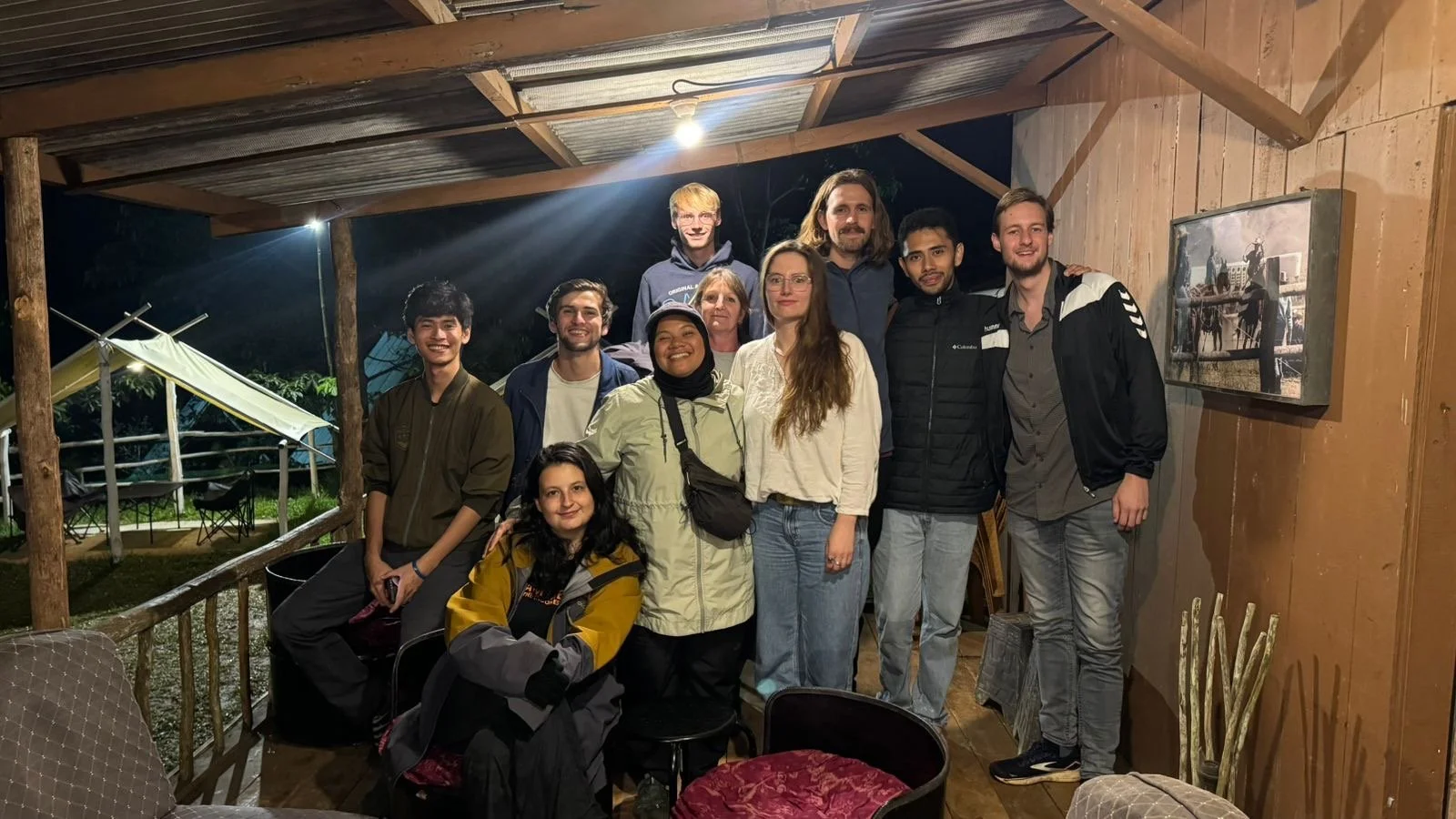
THE TEAM: Some of the volunteers at Cikananga Wildlife Centre
The highlight is the sighting of a wild slow norris perched high above us on a wire. We quietly ooh and aah as he stares balefully down. Suddenly, as if he’s remembered he left the oven on, he’s off at a pace that suggests he really doesn’t know his name.
I’m given the official tour by Lorenza in the morning, assuring her around the halfway mark that I have no sense of direction and will get lost. She assures me it’s basically a circle; I assure her that isn’t relevant. All the enclosures, be they for birds, mammals or reptiles, are carefully sited away from the main track to minimise human contact.
This is no tourist attraction or zoo. The most successful outcome hoped for is re-release, though for many residents this isn’t an option. Often rescued from a thriving illegal pet trade, where infant animals are openly sold in markets, most are unable to survive in the wild and look to people for food and attention, or are traumatised by their experience. In these cases there is a gentle de-humanising process and constant enrichment is used to encourage natural behaviour. (More on enrichment at a later date, or as I like to call it, Andy’s Arts and Crafts Shed.)
Throughout the tour, the response to my ‘can I talk to these?’ was a resounding no, apart from the giant turtles. I’m allowed to talk to them. Over the next few weeks those turtles are getting a good talking to.
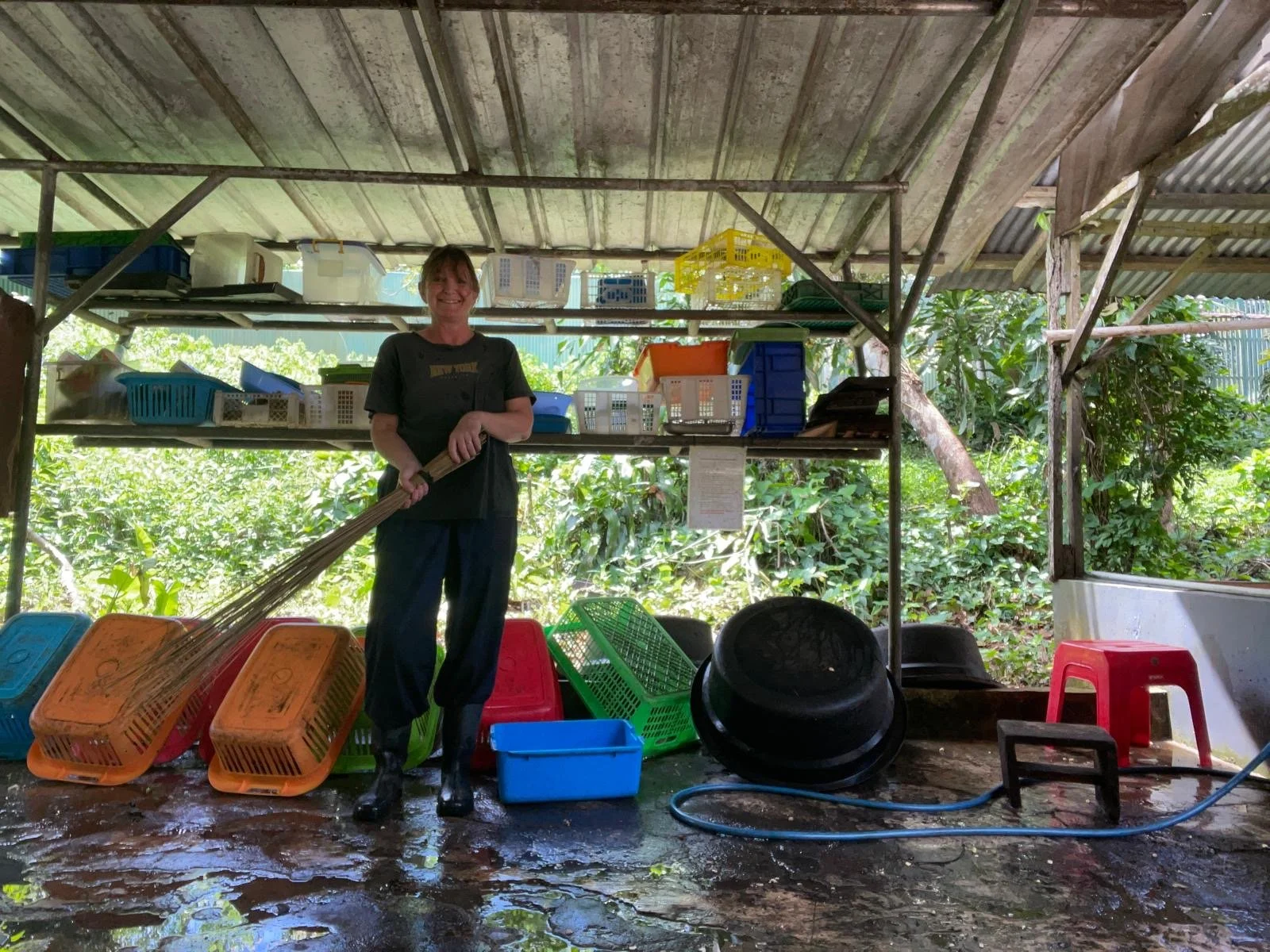
‘IT’S ALWAYS HARD WORK, WHICH I’M FINE WITH’: Kath on sweeping duty at the food house
Work begins here at 7am, when everyone meets at the rusty gate (it’s the humidity!) then heads into the centre, up hill and down dale to the food house, the central hub; a hive of activity to rival the bees (which are huge and sometimes come in blue). All the keepers and volunteers set to work preparing the varied diets specific to each species.
Vast quantities of fruit and vegetables are chopped, packed into baskets and together with raw chicken, live crickets, mice, and buckets of writhing cat fish, are loaded onto bike trailers and go away with with our assigned keeper. All are local Indonesian men who are endlessly cheerful and patient with us. They like to practice English, which is the communal language of the centre, and regularly make me smile, shouting “You got bottle o’ wa-ar mate?” (Clearly there’s been some London influence here before me and I plan to teach them the versatility of the word ‘bugger’ before I leave!)
“It’s a bumpy old ride in the back and an occasional lively catfish makes a bid for freedom, but everything ends up delivered where it’s supposed to be. My first feeding duty is the great giant chickens.
Also in blue, the giant chickens, or Cassowaries, are possibly one of my favourite residents here. These majestic fighting birds, hailing originally from Papua New Guinea and Queensland, are as tall as me, and look like a cross between Rod Hull’s Emu and a velociraptor. Capable of killing a human, they prefer to just try and kill each other so are separated by sturdy wire fencing.
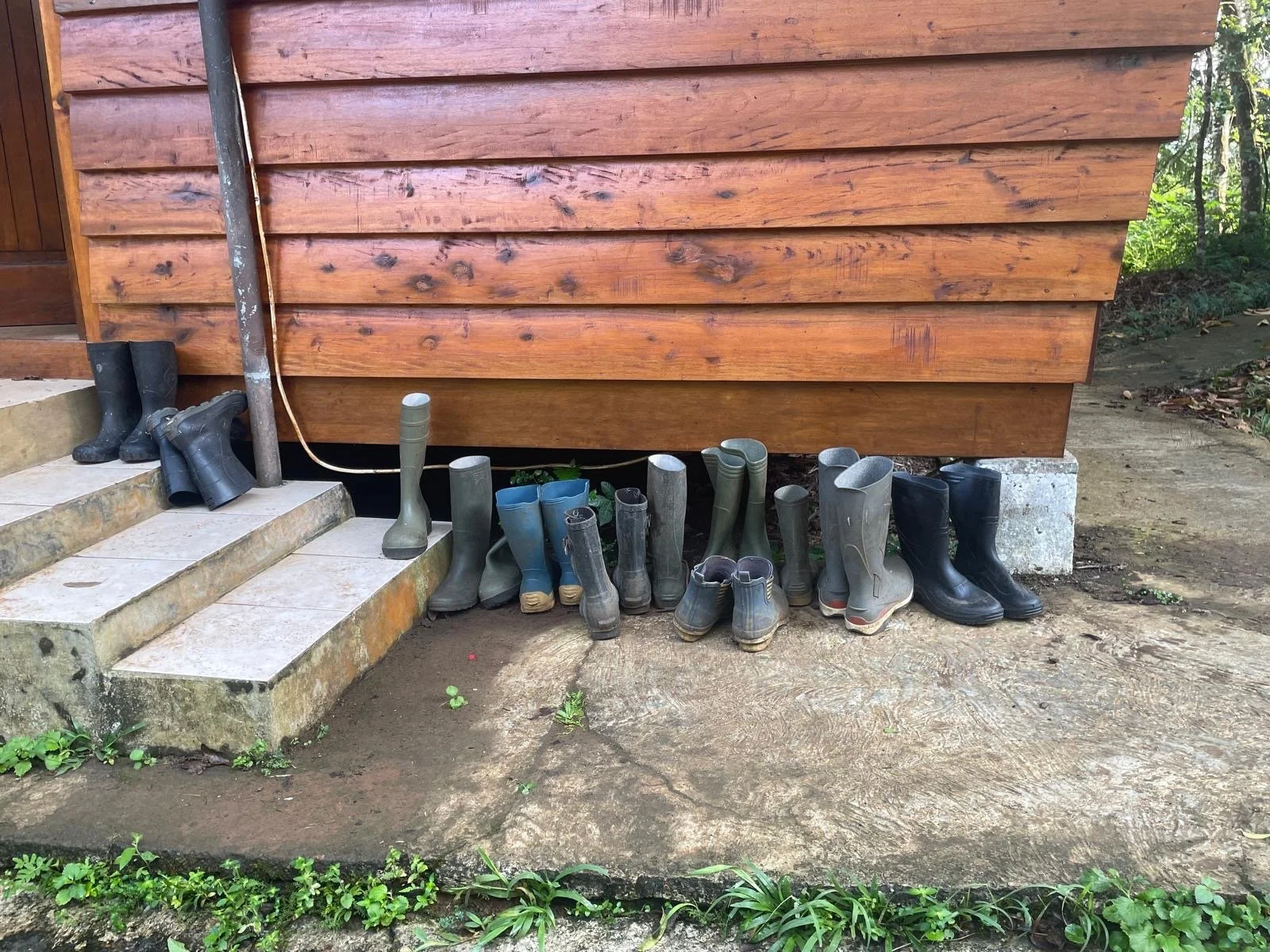
THE BOOTS OF VOLUNTEERS PAST: People bring wellies to the centre but never take them home
Their enclosures are set in a shaded valley where they have trees and plenty of space to dig and wander and glare at each other. With 15 of them, the centre is at full capacity. Nobody wants them back. (I’d like to bring one home but really don’t have a suitcase big enough.) Huge buckets of deliberately over-ripe fruits are chopped with added corn cobs and bananas to mimic their natural, forest floor foraging diet. As I place baskets down they eye me with a look that says if they wanted they could give me a really good kicking.
I get a different look from the macaques. These naughty monkeys, when fastened in the back cages, will bounce around and try and grab anything through the bars as I attempt to clean their main enclosures. Brushes, hats, arms, anything they can retrieve and chew on. You really have to keep a sharp eye out.
Them monkeys is long of arm and fast! Two young, long-tailed ones are particularly messy (like a teenager’s trashed bedroom, it often reminds me of the state of the canteen after the Dutch boys have partied hard). Meanwhile, two much larger, muscular males sit calmly, man-spreading, displaying their substantial wares (and sometimes fiddling with them). Their hard stare tells me they’re confident that as soon as they work out how to undo the locks, they’re going to eat my face.
Each day is the same but different as we spend time with different happy keepers in different areas of the centre. Always there is hard work, which I’m fine with. Indonesian is a language with no unnecessary words so I skip about asking if they need me to choppy-choppy / scrubby-scrubby / sweepy-sweepy. The answer is usually yes.
It’s not considered at all rude to ask someone’s age (and I’ve never understood the western issue with it) and when I tell them I’m 57 they exclaim “Oh, you are very old!” But follow it up with “you are very strong!” Yes, I am thank you. I’m doing OK I think. Not bad for an old bird.