
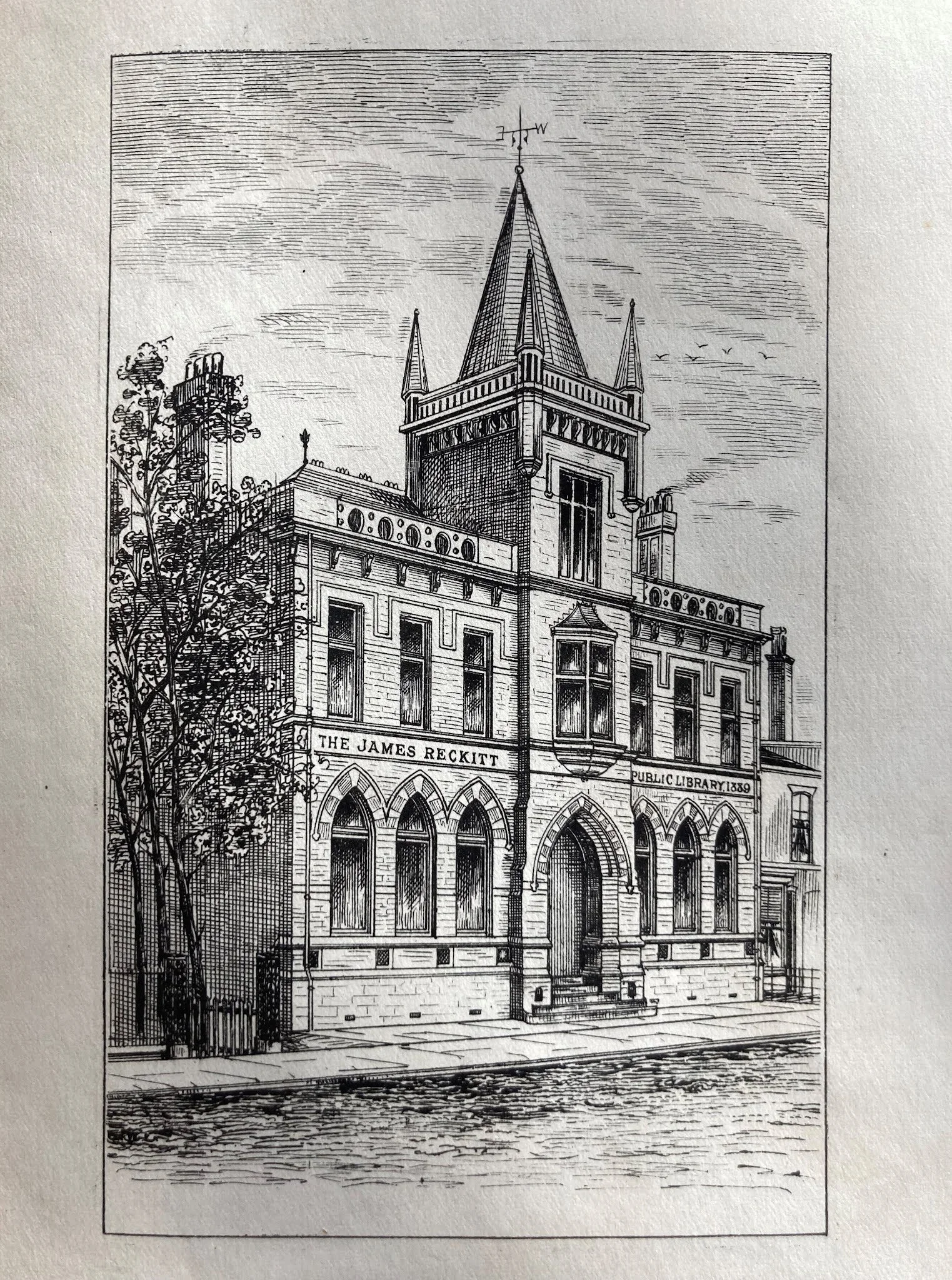
PIONEERING: An illustration of the James Reckitt Public Library, Holderness Road, late 19th century

The Way it Was
In partnership with Hull History Centre
By Neil Chadwick, archivist/librarian
The catalyst for library provision began in the mid-19th century with the Free Library Act.
This allowed municipal corporations to levy half a penny in the pound to provide what we would describe today a public library service. Despite this, uptake was slow. By 1867, only 27 municipal authorities had adapted free library provision.
It appeared there was much work to do, including here in Hull. In Hull the Public Libraries Act was met with outright resistance with the town ‘by an overwhelming majority’ rejecting its adoption.
Despite this there was a growing momentum, particularly among the philanthropist class. In 1888, Sir James Reckitt invited a small number of individuals who were in favour of a free library in the Borough of Hull. Those invited were from local business and politics. Notable names included that of the Priestman family, Thomas Ferens, Councillors Morrill, Maddison and Garside as well as members of Sir James’s own family.
Thanks to the surviving Minutes of the General Committee of the James Reckitt Public Library held here at the Hull History Centre, we take up the first part of the story at 7pm on September 21, 1888…
The meeting was opened by Sir James. He began by discussing a scheme for a library in the east district of Hull – to be known as The East Hull Free Library.
Sir James expressed his regret (and no doubt disappointment) of the rejection that the rate payers of Hull had refused to adopt the Public Libraries Act. Not to be deterred, he believed that such provision for a public library could work.
It was proposed that a rate of one penny in the pound could be raised against rateable property in the east of the town. Sir James himself would subsidise annually a sum equal to that of a rate of one penny in the pound on all the rateable property, which was estimated to be £500 each year.
To further argue his case, Sir James would advance £5,000, a sum which he estimated to be sufficient for buildings and books for the people in the district of East Hull. Added to this, Sir James stated that should the town at any time decide to adopt the Public Libraries Act, then he would hand over, free of charge, the buildings and its books. Sir James then asked those invited for their thoughts and opinions.
Overall, his proposal for a free library in the east of Hull was met with great enthusiasm. There were some minor concerns, such as those expressed by Alderman Stuart, who suggested the importance of a reading room which had been overlooked by Sir James. He also had concerns in terms of the library’s size, which he expressed might not be large enough unless confined to the residents of East Hull.

FASCINATING RECORD: General Minute Book of the James Reckitt Public Library
Councillor Garside also expressed his preference for a reading room, which he felt should be confined to East Hull residents. The motion of a free public library in East Hull was carried unanimously by those in attendance.
The following month the committee met to discuss the site for the new library. Several possible locations were identified. These included the Old British Schoolhouse on Dansom Lane, a plot of land named Kerman’s Square and a block of three houses in Somerstown. The committee felt that a site close to the Holderness Road was to be most suitable, ideally by or close to Williamson Street or Wilton Street.
An initial offer of £1,000 was made against the three properties in Somerstown, close to the junction of Holderness Road, Dansom Lane, on Holderness Road's southside. The offer was made against property adjoining Messrs, Cusson’s Stores, which was the property of Mrs Frost and Miss Barnett. The offer was refused. A revised offer of £1,200 was made, which if accepted, the property was to be obtained by the committee within three months. If, however, the purchase of these three properties was to fall through, then the committee was empowered to purchase the Kerman’s Square site.
The purchase of the three properties in Somerstown fell through, and on November 28 the committee met and agreed with a Mr G J Butterworth to purchase the Kerman’s Square site, subject to the purchase being obtained by March 1 the following year. On February 14, 1889 the committee confirmed the purchase of Kerman’s Square for £1020-16s-8d.
The tender for the building of the new library was put out, and it was recommended that Mr F Blackburn of Peel Street be given the tender for £1,446-9s-6d. The ceremony for the laying of the foundation stone was to take place at Kerman’s Square, Holderness Road, on Monday, April 8, 1889. The Mayor and Sheriff were invited to the laying of the foundation stone. Sadly, Sir James was unable to attend in person, though he did pen a letter to the Hull Express on April 9 in which he set out the library's main objectives to satisfy the aid of knowledge but also aid the town’s inhabitants and serve in their education.
The library opened on December 10, 1889. In the first week 508 books were borrowed, equating to 101 for each day. By the end of the month this had jumped threefold to over 1,500 weekly borrows, with a daily average of 305. Its use and subsequent borrowing increased. By the end of September, the following year the library borrowed a total of 81,600 books, a daily average of over 300. The number of borrowers totalled 3,857.
For the residents of East Hull, the library was an invaluable resource. For one resident, the library enabled them to pass an examination connected with their employment, ‘which would have been impossible without such a library’.
The success of the East Hull Free Library had by now raised calls for free library provision across Hull. Joseph Temple offered his library of 7,000 books to the Corporation having realised its value since the foundation of the East Hull Library by Sir James. Despite this, the town had continued to rebuff attempts to introduce free libraries, much to the ‘shame and discredit of a town ranked as Britain’s third port in the United Kingdom’.
In December 1892, polling was carried out to adapt the Public Libraries Act in Hull. It was a close-run vote. Those in favour won by 942 votes with 13,139 in favour, while 12,197 were against. True to his promise, Sir James handed over the now named James Reckitt Public Library to the newly formed Public Libraries Committee of Hull Corporation on October 2, 1893. Sir James’s vision of free public libraries in Hull had eventually won, overcoming previous rejections.
On November 16, 1893, the committee of the former East Hull Free Library met for the final time. Sir James thanked the committee members for the last five years. Thanks were echoed by Councillors Holden and Morrill for the committee’s services since its foundation five years earlier in September 1888. The meeting was signed off for the final time by Sir James.

HANDING OVER: The final signing off by Sir James Reckitt at the Public Library General Committee in October 1893
There is little doubt that Sir James was a man ahead of his time. He was one of the first in Hull to understand matters that affected the town’s working classes. He felt a sense of duty and responsibility, not only to the welfare of his employees, but also to Hull’s townsfolk. His understanding of social issues led to Sir James also supporting hospitals and children’s homes in Hull. He realised the importance of libraries and the role their played for the community. For without them, many had no access to books, education and the enjoyment of reading.
On top of the existing services, libraries today continue to evolve, offering new and innovative services. They are open to everyone and make positive contributions to the communities in which they serve.
Undoubtedly, without Sir James, it may have taken library provision a while longer to succeed in Hull. Sadly, the James Reckitt Library is now closed. The building still exists but has since been turned into flats. The outside however remains a reminder of its important role of library provision in years gone by. There is little doubt that such a building is as important to Hull’s heritage as Wilberforce House, the Old Grammar School, the Maritime Museum and so on.
Despite no longer being a library, Sir James and the subsequent trust that bears his name, continue to this day to support Hull’s public libraries. The role of libraries has changed, but their very existence is to provide inclusion for all, as well as aid the love of reading, learning, to ensure social mobility and community cohesion for those in which they serve. To date, the James Reckitt Library Trust has provided £5m towards various projects and activities, not only to improve literacy and encourage the love of reading but also to aid library sustainability for future generations.