
Clocking off: Guildhall Time Ball to be taken down for repairs
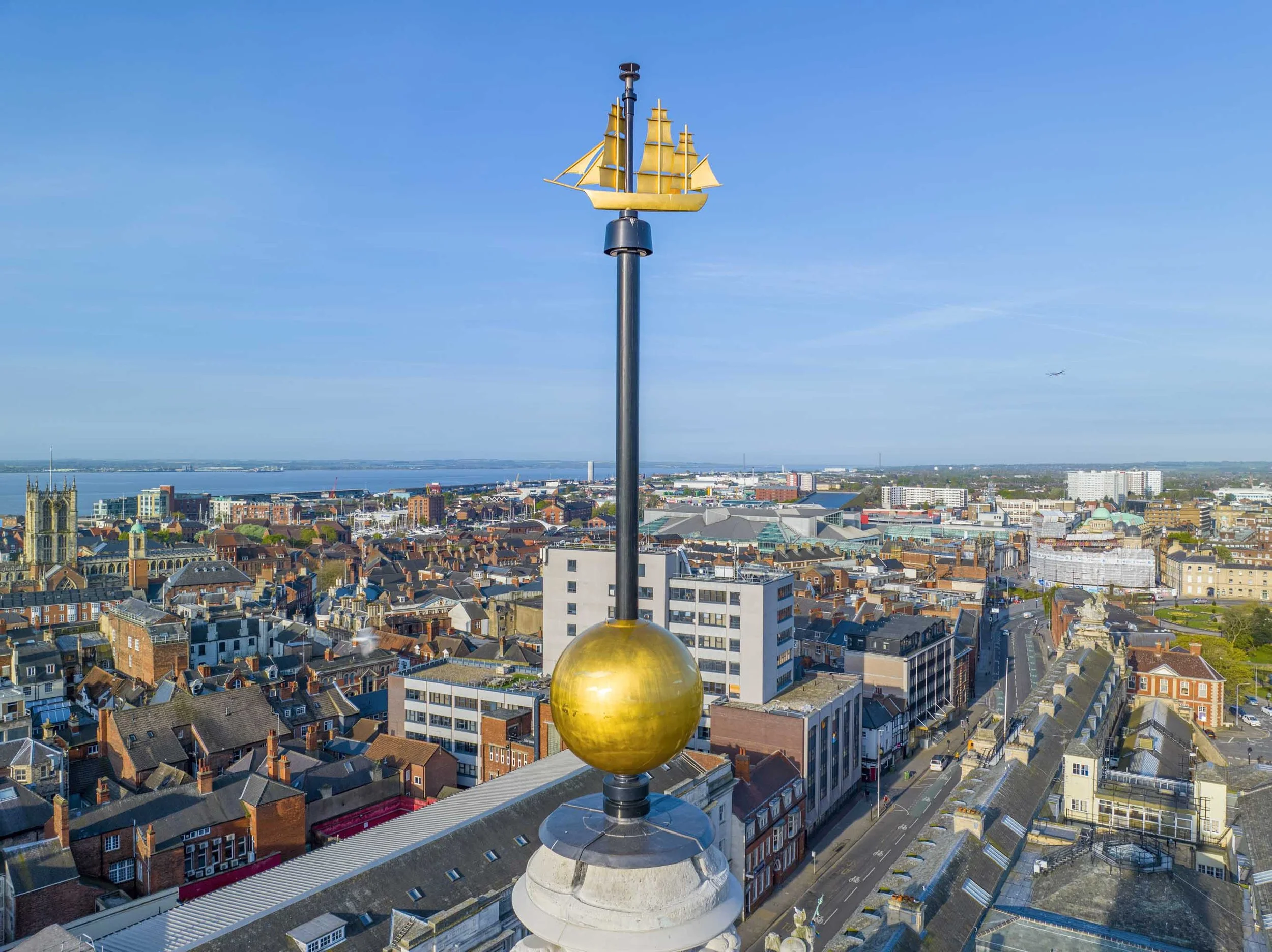
LANDMARK: The Guildhall Time Ball in pride of place over present-day Hull
EXCLUSIVE
By Simon Bristow, Co-Editor
The historic Guildhall Time Ball is to be taken down for repairs after a stuttering reintroduction since becoming operational again for the first time in 100 years.
The Time Ball, originally designed as a navigational aid for shipping, was brought back into working order in June 2023 after the city council secured a £281,000 grant from the Heritage Lottery Fund. It stopped working just weeks later after a mechanical fault, but was fixed and working again until a further breakdown on March 27 this year.
The distinctive and rare device will now be removed for repairs on Sunday, July 13, with the original contractor, Smith of Derby, covering the cost.
The removal will force the closure of Lowgate outside the Guildhall between 8am and 4pm, with diversions in place via George Street, Vernon Street, Queens Dock Avenue, Alfred Gelder Street and Great Union Street.
At 196ft (60m) above ground level, it is the highest Time Ball in the UK and one of the last remaining examples of its type in Britain.
Installed between April 1915 and November 1916, it had been out of use since its motor was removed in 1922.
The Time Ball was an essential aid to mariners on the rivers Hull and Humber, rising in the summer at 12.57pm each day until it dropped at precisely 1pm on a signal from Royal Observatory Greenwich. Sailors could then accurately set their chronometers, allowing them to determine their longitude at sea, and therefore their precise location. The Time Ball dropped at noon in winter.

The Time Ball is over one metre in diameter and is covered in 23.5 carat gold leaf. Beneath it, four Putti, which are Cherub like creatures that do not have wings, hold up the Time Ball on a cup.
Its instalment in Hull reflected the city’s prominence as a major UK port with strong links to the fishing industry and worldwide trade. It was originally operated by the General Post Office who manually raised the Time Ball each day for a fee of £5 per year.
City council leader Mike Ross said: “It is disappointing that the internal parts have failed, causing the Time Ball to stop working. However, the council is committed to ensuring this historic feature is restored to full working order. We appreciate the public’s patience while this essential work is carried out.”
Paul Litchfield, from Smith of Derby, said: “While the mechanism that controls the rise and fall of the Time Ball may appear simple from the outside, the internal system is in fact highly complex. It uses advanced magnetic technology to allow the ball to levitate, generating forces that, over time, have led to an unforeseen failure in a low-maintenance bearing. This component is integral to both the internal drive mechanism and the time ball assembly itself.
“It’s important to note that all components of the Time Ball were thoroughly tested prior to installation. However, it is extremely difficult to fully replicate the stresses and strains the structure experiences once exposed to the real-world effects of temperature fluctuations, weather, and coastal conditions.
“Removing the Time Ball is not a decision we take lightly. However, it is a necessary and critical step to ensure that all components are upgraded to the same specification. This will help guarantee the long-term performance, reliability, and longevity of the Time Ball.”
The Time Ball will be taken to the contractor’s workshop, where the upgraded components will be installed and tested under controlled conditions. It will be reinstalled once testing is complete.