
Civil war, anarchy and the rise of Bransholme Castle

GOING UP IN SMOKE: Bayeux Tapestry showing a motte and bailey castle being besieged by soldiers

The Way it Was
In partnership with Hull History Centre
By Neil Chadwick, archivist and librarian at Hull History Centre
Last year we told the story of Sir John, lord of Sutton who was fined for having built a castle at Bransholme.
This is taken as the first cited reference to a castle at Bransholme. The truth is Bransholme Castle can trace its origins back to the twelfth century - back to a time of civil war and anarchy.
This is the story of Bransholme Castle in the twelfth century.
It’s December 1135 and King Henry I is dead. His nephew, Stephen of Blois usurps the crown of England. Civil War has broken out between King Stephen and the daughter of Henry I, Matilda.
Incidentally Matilda and Stephen are cousins. Whilst Stephen and Matilda fight it out, the nobility and lesser men use this civil war as a smokescreen to settle old scores and attack their neighbours and enemies for political, social and economic gain.
William of Amuale, Lord of Holderness and Earl of York fights for King Stephen. But seeking an opportunity to expand his Yorkshire estates, William attacks his neighbour, Gilbert de Gant, whose lands were centred around Bridlington.
The Anglo-Saxon Chronicle noted: ‘Across the country ‘the land was filled with castles full of evil and wicked men… and men said openly that Christ and his angels slept’ (AD 1137).
This period, also referred to as The Anarchy, witnessed the largest upsurge in castle building since the Norman Conquest some 70 years before.
Some chroniclers reported upwards of 1,000 castles were built, whilst others give a more conservative figure of a couple of hundred. Whatever the number, more castles sprang up across the land.
Countering Gilbert de Gant, William of Aumale fortifies Bridlington Priory with a castle type structure. William goes on to build the castle at Scarborough before destroying the de Gant castle at Hunmanby.

CENTURIES LATER: The sale of Castle Hill by Hull Corporation, 1668
As the overlord of Yorkshire, William ruled over the county and its inhabitants. One of William’s vassals was Sayer I, Lord of Sutton. Sayer held his Sutton lands from William. In return, Sayer, and those like him would provide military service when called upon.
So, when William sided with Stephen and waged private war against Gilbert de Gant, Sayer would have been called upon to fight at William’s side. In doing so, Sayer was in the firing line of both Matilda and Gilbert de Gant’s forces.
What was to say that de Gant, or Matilda wouldn’t come riding to this part of the world and strike back against William or his supporters? Sayer too was no doubt concerned by such thoughts. So, like many of his peers, he takes precautions and builds himself a castle. Bransholme Castle to be precise.
Sayer was one of the early Lords of Sutton. He, together with his descendants, would become one of the area’s leading families both socially and politically. Their lands not only included what was Sutton, but also Southcoates, Stoneferry and Bransholme. Sayer II, for example, provided the nuns of Swine access to Drypool through his lands at Southcoates, along what became the Holderness Road.
Sayer II was also the King’s bailiff on the River Hull. He is reputed to have lived at Stoneferry to control the River Hull. A descendant of both Sayer I and II was Sir John de Sutton. Sir John fought in the Hundred Years War with France. It was this Sir John who was responsible for the re-building of Bransholme Castle in the fourteenth century.
There is no documented evidence to say that Sayer I was the builder of Bransholme Castle. Nor is there any archaeological evidence to confirm this. It’s accepted that Sayer I was the original builder of Bransholme Castle as those castles that cannot be dated, like at Bransholme, are widely accepted as being founded during this period of civil war and anarchy.
As law and order broke down, royal administration crumbled. It was a free for all, and anyone who could build a castle, did.
We know Sayer I was living around 1156 which puts him in and around the time of this civil war. He was witness to a charter in 1152, which implies he was of age, an adult if you like as the war was drawing to its conclusion. And to protect himself against reprisals, say from Matilda or more likely Gilbert de Gant, Sayer built himself a castle. William of Aumale may have even helped Sayer with the castle’s construction or gave him a thumbs up at least.
Bransholme Castle was in the motte and bailey style. This was still the blueprint for castles brought over by the Normans since 1066. The motte is a great mound in which the tower or keep was situated. The keep served as the living quarters and was a place of last refuge when attacked. Below was the bailey. The bailey housed all the ancillary buildings needed for its day to day running. It varied between castles but may have consisted of kitchens, stables, perhaps a small chapel all of which was surrounded by a wooden palisade and ditch.
Luckily for Mr and Mrs Sutton, Bransholme Castle was never attacked or besieged. Being in marshland and surrounded by meres and carrs, (and probably a moat), had a would-be attacker managed to infiltrate Holderness, they would probably be met with a formidable structure. Had Matilda or Gilbert de Gant come knocking, the castle may have been robust enough to repel a full attack. Or at least hold out, allowing for a relief force to break any siege.
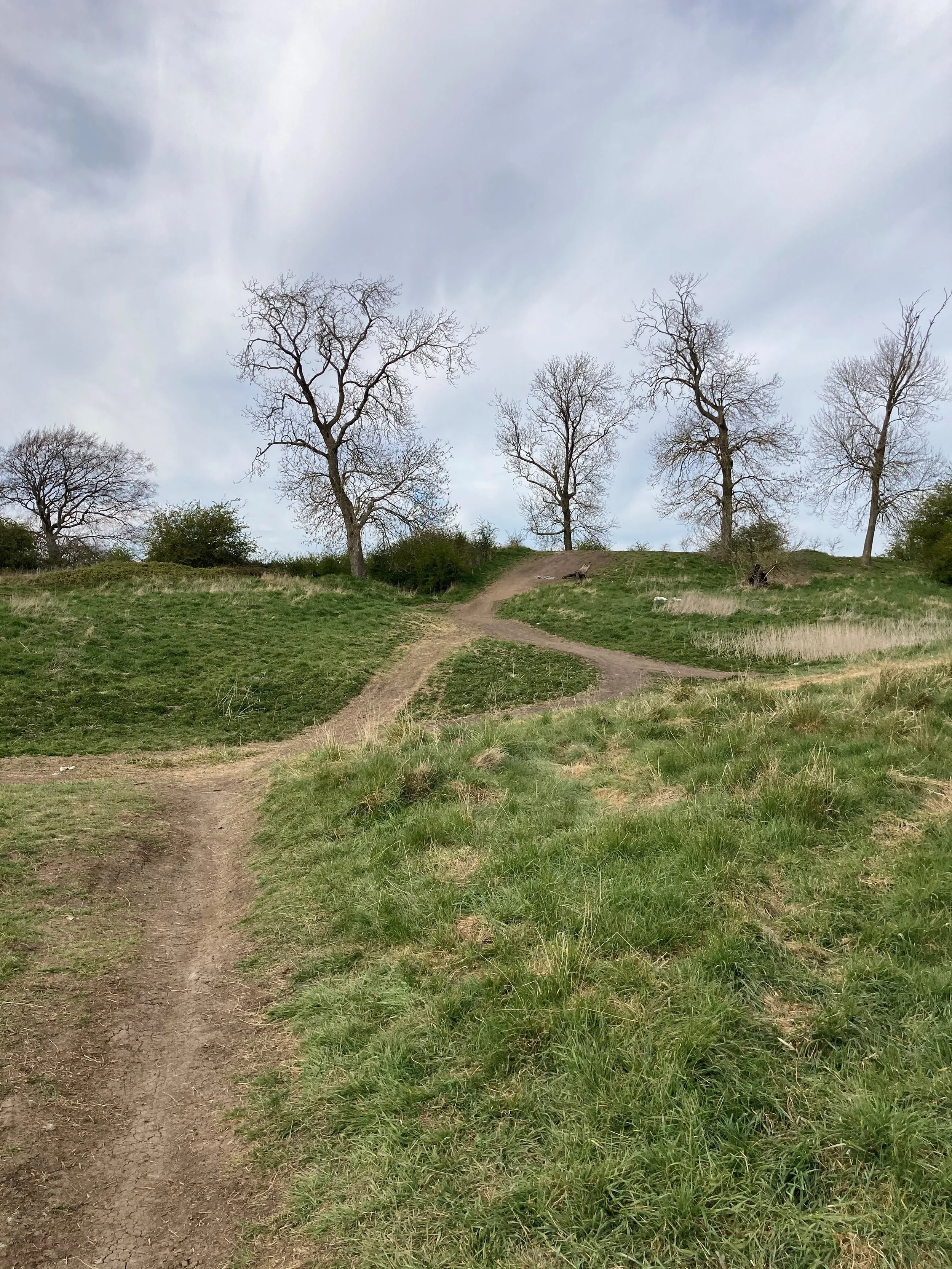
ANCIENT MONUMENT: The remains of the motte at Castle Hill today
At this time almost all castles, except for a small few, were built of timber. Even Clifford’s Tower at York remained a wooden castle until the 13th century. The flaw with wooden castles is of course that they can easily go up in smoke. And we see this in the Bayeux Tapestry. For the Sutton family any would-be attackers forgot the Swan Vesta’s, or they got wet whilst navigating the marshes of Holderness.
Many of the key castle locations were taken with the first wave of castle building 70 years earlier with the Norman Conquest. These castles held strategic locations. They controlled lines of communication, dominated towns and became centres of administration. With all the best spots taken, it is not surprising to see many castles from this period built in low lying or marshy areas, which made them difficult for an enemy to reach. A perfect bolthole in times of trouble.
Why didn’t Sayer build a castle at Sutton? There are a few reasons for this. Firstly, to build a castle from scratch, Sayer would have required people power. Quite a lot of people power to just raise a motte. The motte at Hamstead Marshall for example would have taken 50 men around 80 days to build. For a minor lord like Sayer, that is a lot of resources and that’s before he accommodates and feeds them.
To build a castle you needed engineers. The motte cannot simply be piled up. It needs to be layered to make sure it doesn’t wash away at the first sign of rain. And with castle building in demand, getting the expertise to build a castle would have proved difficult the further down the pecking order you are.
So, looking out from his nice two-up-two-down in Sutton, thinking about who may come for him, perhaps Matilda or de Gant, even both, Sayer notices the hillock or mound beside his land at Bransholme. ‘Great’, he thinks. Even with limited resources it is something Sayer can work with, something to manipulate into his own motte and bailey, a bolt hole in times of trouble.
This is merely a hypothesis. That said, if Sayer I was the reputed builder of Bransholme Castle then it goes someway to explaining why the castle at Bransholme came into existence.
Peace was eventually reached between Stephen and Matilda after nearly 20 years. Stephen remained as King of England, but the crown was to revert to Matilda’s son, Henry Plantagenet, who was to become Henry II.
Within a year of Stephen and Matilda’s truce, Stephen does the country a favour and dies. Henry II comes to the throne. He orders all castles built without royal permission to be destroyed (in the case of Scarborough Castle turned over to the crown).
Presumably Bransholme Castle was destroyed. Or was it? In 2023 a couple of fragments of pottery were found on the site. These fragments dated to late 12th/early 13th Century, suggesting Bransholme Castle may have remained occupied or was perhaps re-occupied in the decades after.
Bransholme Castle continued to hold a presence in the landscape for the next two 200 years by the descendants of Sayer I.
The site is open to the public and is popular among residents as a place to walk dogs as well as a place for children to explore its mounds. Please be aware that, whilst open to the public, the site is a scheduled ancient monument and protected in law.